Askari Bank (PSX: AKBL) published its results for the three and nine months to 30 September 2026 on 22 October 2026. Figures below are for the bank on its own (unconsolidated).
The headline: a profit after tax of Rs 7.17 bn, or Rs 4.95 a share, for July to September, down 3.6% from Rs 7.44 bn (Rs 5.13) a year earlier. For the nine months, profit rose 13.5% to Rs 20.5 bn (Rs 14.15 a share against Rs 12.46). The board declared a third interim cash dividend of Rs 2 a share, taking the 2026 interim payouts to Rs 6.
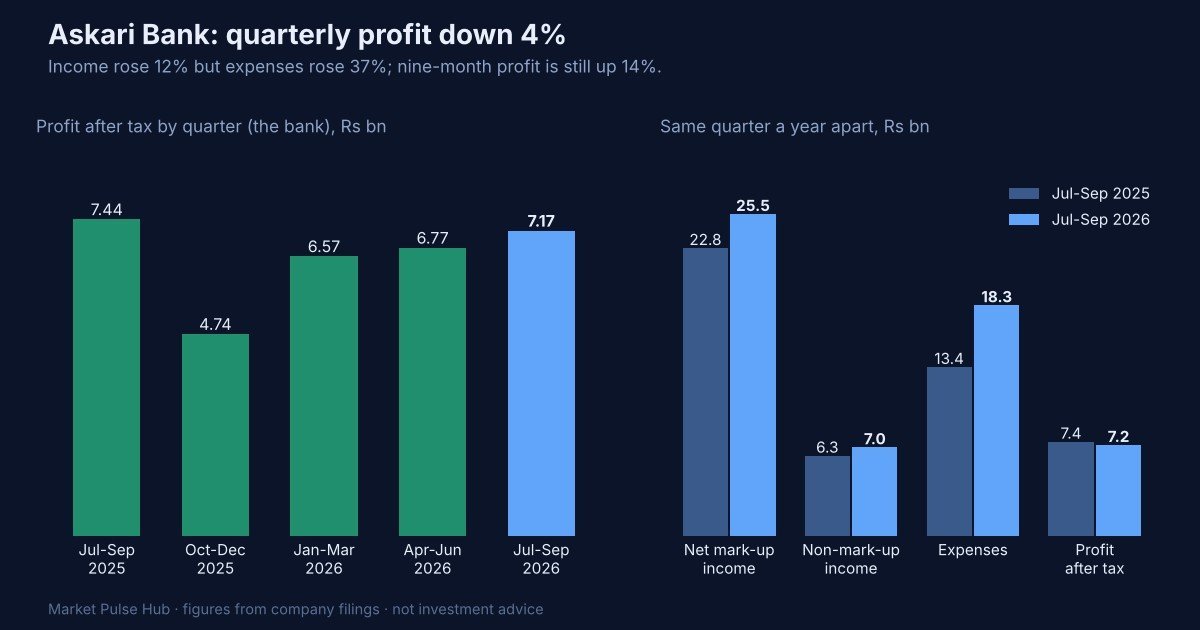
The quarter in numbers
| Rs M | Jul to Sep 2026 | Jul to Sep 2025 | Change |
|---|---|---|---|
| Mark-up / interest earned | 85,192 | 76,529 | +11.3% |
| Mark-up / interest expensed | (59,685) | (53,723) | +11.1% |
| Net mark-up income | 25,507 | 22,806 | +11.8% |
| Fee and commission income | 2,384 | 2,349 | +1.5% |
| Foreign exchange income | 3,682 | 1,567 | +135% |
| Gain on securities | 696 | 2,063 | −66.2% |
| Dividend and other income | 230 | 349 | −34.0% |
| Total non-mark-up income | 6,992 | 6,327 | +10.5% |
| Operating expenses and other charges | (18,268) | (13,366) | +36.7% |
| Profit before credit loss allowance | 14,231 | 15,767 | −9.7% |
| Credit loss allowance | 1,173 reversal | (172) charge | |
| Profit before tax | 15,405 | 15,596 | −1.2% |
| Tax (effective rate 53.4% against 52.3%) | (8,232) | (8,157) | +0.9% |
| Profit after tax | 7,173 | 7,439 | −3.6% |
| Earnings per share, Rs | 4.95 | 5.13 | −3.5% |
What drove the result
Income grew well. Net mark-up income rose 12% in the quarter and 6% over nine months to Rs 69.5 bn. The bank says average earning assets grew about 20%, which more than made up for an average policy rate about 0.5 percentage points lower than a year earlier. Foreign exchange income more than doubled in the quarter to Rs 3.7 bn, while gains on securities fell to Rs 0.7 bn from Rs 2.1 bn. For nine months, non-mark-up income rose 50% to Rs 19.6 bn, with fees up 29%, foreign exchange up 104% and capital gains of Rs 4.3 bn.
Costs grew faster. Operating expenses and other charges rose 37% in the quarter to Rs 18.3 bn, and 38% to Rs 47.3 bn for nine months. The bank links this to branch expansion, technology, staff and marketing: its network grew to 820 branches from 757 a year earlier. The cost-to-income ratio rose to 56% in the quarter from 46%, and to 53% for nine months from 44%. Management says cost growth should slow as cost-saving measures take effect.
Provisions helped. A net release of credit loss allowances of Rs 1.17 bn in the quarter, against a Rs 0.17 bn charge a year earlier, kept pre-tax profit almost level. Tax took 53% of pre-tax profit, so after-tax profit fell slightly more.
The balance sheet
- Bigger and cheaper deposits. Deposits rose 11.7% since December to Rs 1,822 bn. Current deposits grew 42%, an increase of Rs 210 bn, lifting the current account ratio to 39% from 31%.
- Lending up. Advances grew 12% during the period, according to the bank, to Rs 667 bn net, from both corporate and consumer lending. Investments were Rs 2,059 bn, still the larger part of the balance sheet.
- Asset quality and capital. The infection ratio was 4.3% with coverage of 120%. The capital adequacy ratio was 18.04%. Total assets rose 6% to Rs 3.06 trillion.
- Rating upgrade. PACRA upgraded the long-term rating to AAA, its highest, from AA+.
- Islamic conversion. More than 70% of the branch network is now Islamic, and the remaining branches are planned to convert.
Valuation snapshot
At the 28 October close of Rs 108.91:
| Measure | Value |
|---|---|
| Earnings per share, last 12 months (October 2025 to September 2026) | about Rs 17.4 |
| Price to earnings | about 6.3 times |
| Book value per share | about Rs 107.2, so price to book of about 1.0 |
| Dividend run rate (Rs 2 a quarter, so Rs 8 a year) | a yield of about 7.3% |
| Market value (1.45 billion shares) | about Rs 158 bn |
| Share price, last 52 weeks | low Rs 73.22, high Rs 125.29 |
The stock trades at about its book value and a little over 6 times earnings, about 13% below its 52-week high.
What to watch next
- Costs. The key number. Expenses rising almost three times as fast as income cannot continue for long without hurting profit, so watch whether the promised slowdown shows up.
- Net mark-up income. Whether growth in earning assets and cheaper deposits keep lifting it if rates fall further.
- Provision releases. They helped this year; a return to charges would weigh on profit.
- Foreign exchange and trading income. Both are volatile and made a large contribution this year.
- The dividend. Rs 6 of interims so far in 2026, against Rs 5 in total for 2025 (three payments of Rs 2, Rs 1.25 and Rs 1.75, as shown in the bank’s statement of changes in equity). A final dividend for 2026 would come with the annual results.
The bottom line
Askari Bank’s business grew strongly, with higher deposits, more lending and rising income, but a 37% jump in expenses meant the third quarter’s profit came in slightly below last year’s. Over nine months, profit is still up 14% and the dividend has stepped up to Rs 2 a quarter. Whether the heavy spending on branches and technology pays off is the main question for next year.
You can follow AKBL’s price, Pulse Score, dividend history, results calendar and off-market trades in the Market Pulse Hub dashboard under PSX.
Bilal, Market Pulse Hub
Source: Askari Bank Limited, quarterly report for the nine months ended 30 September 2026 (directors’ review and unaudited unconsolidated condensed interim financial statements). October to December 2025 profit is derived from the 2025 annual result less the nine-month figure. Prices from the PSX data portal. Twelve-month, per-share and valuation figures are our calculations. This article is for education and information only and is not investment advice.