Ghani ChemWorld Limited (PSX: GCWL), the chemicals arm of the Ghani Global group, filed two documents with the Pakistan Stock Exchange on 28 October 2026: its results for the three months to 30 September 2026 (the first quarter of its 2027 financial year) and the certified resolutions of its annual general meeting held the day before. We cover both here, because they tell one story: a young company whose factory is still losing money, funded partly by selling its stake in a sister company, and whose shareholders have just approved wider room to move money around the group.
The headline: a loss of Rs 67.7 M, or Rs 0.27 a share, against a profit of Rs 63.9 M (Rs 0.26) a year earlier. No dividend, bonus or right shares were announced.
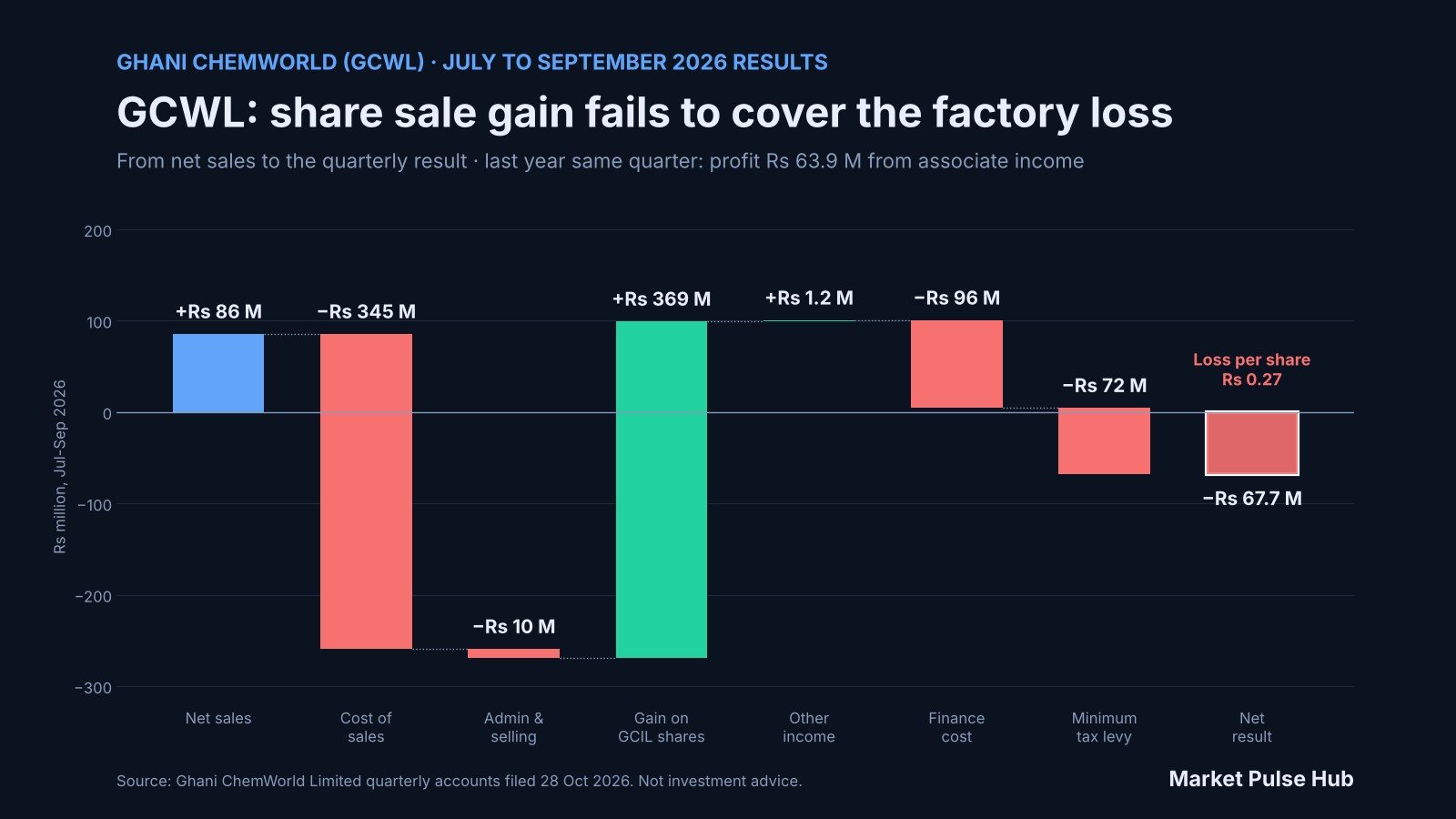
The quarter in numbers
| Rs M | Jul to Sep 2026 | Jul to Sep 2025 |
|---|---|---|
| Sales, net of sales tax | 85.7 | nil |
| Cost of sales | (344.8) | nil |
| Gross loss | (259.1) | nil |
| Admin, selling and distribution | (10.3) | (1.0) |
| Other income, of which gain on sale of GCIL shares Rs 368.9 M | 370.1 | 0.1 |
| Profit from operations | 100.8 | (0.9) |
| Finance cost | (95.9) | nil |
| Share of profit from associate | nil | 64.8 |
| Profit before levies | 4.8 | 63.9 |
| Minimum and final tax levies | (72.5) | nil |
| Profit / (loss) after tax | (67.7) | 63.9 |
| Earnings / (loss) per share, Rs | (0.27) | 0.26 |
What is really going on
The factory is not yet covering its costs. GCWL sold Rs 85.7 M of product but its cost of sales was Rs 344.8 M, four times higher. A gross loss of Rs 259 M on Rs 86 M of sales means the plant is running far below the volume it needs. Depreciation jumped to Rs 23.2 M from Rs 0.2 M a year ago, and fixed assets rose to Rs 4.31 bn, which fits a plant that has recently started operating and is still ramping up. For the full year to June 2026 the company also reported a negative gross margin of about 44%, so this is not a one-quarter problem, and it got worse this quarter.
A one-off gain held the result up. GCWL holds ordinary shares of Ghani Chemical Industries Limited (GCIL), a sister company, which it has classified as “held for sale”. During the quarter it sold part of that holding for Rs 776.1 M in cash. Those shares were on the books at about Rs 407 M, so the sale produced a Rs 368.9 M gain. Without that gain, the company would have lost roughly Rs 364 M before levies in a single quarter.
Finance costs and tax levies took the rest. Interest on its Sukuk and bank borrowings cost Rs 95.9 M, almost as much as the operating profit. A further Rs 72.5 M went in minimum and final tax levies, which are charged even when a company has no taxable profit. With sales this small, much of that charge is probably linked to the share sale, though the filing does not break it down.
Why last year looked better. A year ago GCWL had no sales at all; its Rs 63.9 M profit came entirely from its share of GCIL’s profit. Now that the GCIL stake is held for sale, that income no longer shows up, and the company’s own operations are fully visible.
Where the cash went
| Cash flow, Rs M | Jul to Sep 2026 |
|---|---|
| Cash used in operations, after tax paid | (79.9) |
| Spending on plant and equipment | (218.4) |
| Proceeds from selling GCIL shares | 776.1 |
| Sponsor loan repaid | (400.0) |
| Short-term bank borrowing repaid | (120.7) |
| Sukuk repaid | (50.0) |
| Finance cost paid | (94.1) |
| New partially redeemable shares issued | 125.1 |
| Change in cash | (62.0) |
In short, the GCIL share sale paid for this quarter’s capital spending, the operating cash burn and the repayment of a Rs 400 M loan from the sponsors. Three things stand out on the balance sheet:
- Suppliers are financing the business. Trade and other payables rose by Rs 345 M in three months to Rs 2.19 bn, more than 25 times the quarter’s sales. Without that increase, operating cash outflow would have been much larger.
- Liquidity is thin. Cash fell to Rs 67.8 M. Current liabilities of Rs 2.94 bn compare with current assets of Rs 1.71 bn. Counting the remaining GCIL shares (carried at Rs 1.02 bn) as near-cash brings the two closer, which is why those shares matter so much.
- Debt came down. Sukuk (Rs 700 M including the current portion) plus short-term borrowing (Rs 525 M) total about Rs 1.23 bn, down from about Rs 1.40 bn in June. Equity fell to Rs 3.59 bn, mainly because the Rs 400 M sponsor loan, previously shown inside equity, was repaid.
What shareholders approved at the AGM
The second annual general meeting, held in Lahore on 27 October 2026, passed every resolution. The ordinary business was routine: the accounts for the year to June 2026 were adopted and Ilyas Saeed & Company were re-appointed as auditors. The special business is where the substance is.
1. Selling the rights in GCIL’s Class B tracking shares
GCIL plans a rights issue of Class B tracking shares. As a GCIL shareholder, GCWL will receive Letters of Rights (the tradable right to subscribe). Shareholders authorised GCWL to sell those rights on the PSX during the rights trading period, in one or more tranches, with the board deciding quantity, timing and price. The resolution says GCWL will not subscribe to the new Class B shares itself, and any rights it cannot sell may lapse.
The earlier approval (from an extraordinary meeting on 2 May 2026) to sell GCWL’s GCIL ordinary shares remains in place, with a minimum price of Rs 30.00 per GCIL share. That floor does not apply to the rights. GCIL closed at Rs 32.60 on 28 October, so the market is currently above the floor, which keeps further sales possible.
2. Bigger funding limits for group companies
Shareholders raised the limit on GCWL’s investment in each of three group companies from Rs 500 M to Rs 600 M, to be provided as long-term running Musharakah (an Islamic profit-and-loss sharing arrangement) rather than loans and advances, valid for three years:
- Ghani Global Holdings Limited (GGL), the parent company
- Ghani Global Glass Limited (GGGL), an associated company
- Ghani Chemical Industries Limited (GCIL), an associated company
Together that is up to Rs 1.8 bn of possible exposure to related companies. These are limits, not commitments, but for scale: it is about half of GCWL’s equity and more than 25 times its cash at 30 September. At quarter end the balance sheet already showed Rs 399 M of loans and advances. Minority shareholders will want to see what profit rate these arrangements earn and how much is actually drawn.
3. A 15-year gas supply deal with GCIL
Shareholders ratified Rs 4.34 M of oxygen and nitrogen purchases from GCIL in the year to June 2026, approved purchases from July to October 2026, and approved a 15-year long-term gas supply agreement with GCIL. The amounts so far are small; the length of the contract is the notable part, as it ties the two companies together for a long time on terms that are not published in the filing.
Valuation snapshot
At the 28 October price of Rs 11.90:
| Measure | Value |
|---|---|
| Market value (250.1 million ordinary shares) | about Rs 2.98 bn |
| Book value per ordinary share | about Rs 13.9 (price to book about 0.86) |
| Remaining GCIL shares held for sale, at book value | Rs 1.02 bn, about Rs 4.1 a GCWL share |
| Share price, last 52 weeks | low Rs 11.50, high Rs 25.15 |
| Change over one year | about −39% |
The stock trades near its 52-week low and below book value. A useful way to think about it: the last GCIL sale fetched about 1.9 times book value. If the remaining stake sold on similar terms it would raise roughly Rs 1.9 bn, close to two thirds of GCWL’s current market value. That is an illustration, not a forecast: the price depends on GCIL’s share price, the Rs 30 floor and how much the market can absorb. The rest of the value depends on whether the chemical plant can ever sell enough to make a gross profit.
What to watch next
- Plant volumes and gross margin. The single most important number. Sales need to rise many times over before the factory covers its costs.
- Further GCIL sales and the rights sale. These are the company’s main source of cash today, and both depend on GCIL’s share price staying above the floor.
- Use of the Musharakah limits. Whether money flows out to the parent and sister companies while GCWL itself is short of cash.
- Payables. Rs 2.19 bn owed to suppliers is a large bill for a company of this size; watch whether it keeps growing.
The bottom line
GCWL’s first quarter shows a business still in its expensive start-up phase: tiny sales, a large gross loss, real interest costs, and a tax levy on top. A large gain from selling GCIL shares paid for most of it and let the company repay its sponsors and some debt. Shareholders have now cleared the way to sell GCIL rights too, and to lend more to group companies. The stock is cheap against book value, but that book value rests heavily on a plant that is not yet profitable and on a sister company’s share price.
You can follow GCWL’s sister company GCIL, including its price, Pulse Score and off-market trades, in the Market Pulse Hub dashboard under PSX.
Bilal, Market Pulse Hub
Source: Ghani ChemWorld Limited, unaudited financial results for the quarter ended 30 September 2026 and certified resolutions of the annual general meeting held on 27 October 2026, both filed with the Pakistan Stock Exchange on 28 October 2026. Prices from the PSX data portal. Per-share, valuation and illustrative figures are our calculations. This article is for education and information only and is not investment advice.