National Refinery Limited (PSX: NRL), which runs a fuel refinery and a lube base oil refinery at Korangi, Karachi, announced its results for the first quarter of its 2027 financial year (July to September 2026) on 19 October 2026, and sent the full quarterly report to the stock exchange on 30 October.
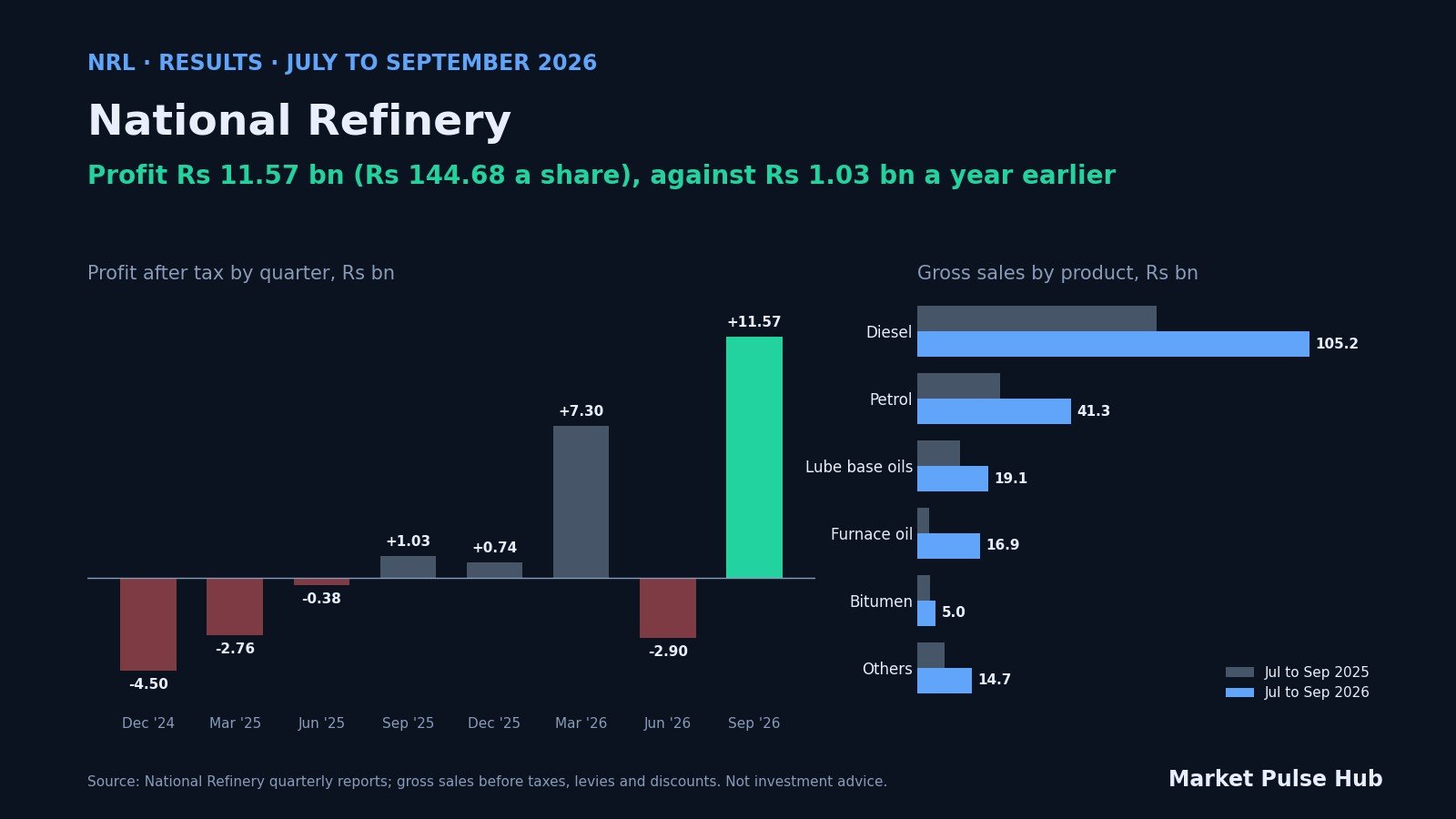
The headline: a profit after tax of Rs 11.57 bn, or Rs 144.68 a share, against Rs 1.03 bn (Rs 12.82) a year earlier. It is the company’s best quarter in at least eight, and on its own it is almost twice what NRL earned in the whole 2026 financial year (Rs 6.16 bn). No dividend was announced.
The quarter in numbers
| Rs M | Jul to Sep 2026 | Jul to Sep 2025 | Change |
|---|---|---|---|
| Gross revenue | 202,256 | 111,870 | +80.8% |
| Taxes, levies, duties and discounts | (49,945) | (32,295) | +54.7% |
| Net revenue | 152,311 | 79,575 | +91.4% |
| Cost of sales | (130,315) | (75,463) | +72.7% |
| Gross profit | 21,997 | 4,112 | 5.3 times |
| Gross margin (on net revenue) | 14.4% | 5.2% | |
| Distribution and administrative costs | (886) | (468) | +89.4% |
| Other operating expenses (mainly workers’ funds) | (1,334) | (95) | |
| Other income | 195 | 91 | |
| Operating profit | 19,972 | 3,640 | 5.5 times |
| Finance cost, net | (1,642) | (1,771) | −7.3% |
| Profit before tax | 18,330 | 1,814 | 10.1 times |
| Taxation (36.9%; mostly deferred) | (6,761) | (789) | |
| Profit after tax | 11,570 | 1,025 | 11.3 times |
| Earnings per share, Rs | 144.68 | 12.82 |
What drove the result
The refinery ran harder. NRL processed about 615,000 tonnes of crude, 81% of capacity, against about 493,000 tonnes (65%) a year earlier. Total sales volume rose about 40%: petrol (Mogas) sales rose about 41% to some 92,000 tonnes and diesel (HSD) about 18% to some 243,000 tonnes.
Margins widened on the Middle East disruption. According to the directors, the breakdown of the US-Iran ceasefire, the continued closure of the Strait of Hormuz and restricted traffic through the Bab-el-Mandeb pushed Saudi crude from about US$87 a barrel in July and August to about US$112 in September, with the Dubai/Oman basket touching US$130 on one day. Freight and insurance costs rose about tenfold from pre-war levels. Product shortages lifted prices and premiums for diesel and petrol even more, so refining margins widened. That more than offset the government’s cost-plus pricing for diesel, which caps the margin NRL can earn on it.
Inventory helped too. At the end of June, finished and semi-finished stock had been written down by about Rs 7.0 bn to its market value. By the end of September only Rs 1.4 bn of that write-down remained. Part of this quarter’s margin therefore came from stock that had been carried at a reduced value being sold at higher prices.
Every product sold more. Gross sales of diesel rose 64% to Rs 105.2 bn, petrol 86% to Rs 41.3 bn and lube base oils 66% to Rs 19.1 bn. Furnace oil sales rose more than five times to Rs 16.9 bn. Exports almost tripled to Rs 15.6 bn.
Lower interest, higher tax. Stronger cash flow reduced working capital borrowing, cutting mark-up costs by about Rs 0.4 bn; net finance cost still includes a Rs 0.38 bn exchange loss on crude imports. Tax came to 36.9% of pre-tax profit, but Rs 4.46 bn of it was deferred tax as the company used up past tax losses, so only Rs 2.30 bn is current tax. Workers’ profit and welfare fund charges explain most of the jump in other operating expenses.
The last eight quarters
| Quarter | Profit after tax, Rs M |
|---|---|
| Jul to Sep 2026 | 11,570 |
| Apr to Jun 2026 | (2,903) |
| Jan to Mar 2026 | 7,302 |
| Oct to Dec 2025 | 740 |
| Jul to Sep 2025 | 1,025 |
| Apr to Jun 2025 | (377) |
| Jan to Mar 2025 | (2,757) |
| Oct to Dec 2024 | (4,496) |
Refining profits swing with oil prices and margins. NRL lost money in the 2024 and 2025 financial years, returned to a Rs 6.16 bn profit in the year to June 2026, and has now earned about Rs 16.7 bn over the last 12 months, or about Rs 209 a share.
Cash and the balance sheet
- Strong cash flow, less debt. Operations generated Rs 20.9 bn of cash, against Rs 1.8 bn a year earlier. Short-term borrowings fell to Rs 24.1 bn from Rs 36.4 bn and total borrowings to about Rs 33.5 bn from Rs 47.7 bn in June. Cash rose to Rs 7.0 bn.
- Customers owe more. Trade receivables rose to Rs 36.5 bn from Rs 22.3 bn, in line with much higher prices and volumes. Trade payables rose to Rs 74.9 bn. Attock Petroleum, a group company, bought Rs 36.0 bn of products in the quarter.
- Equity rose to Rs 68.0 bn, about Rs 851 a share. Of that, Rs 46.1 bn is a revaluation surplus on leasehold land; without it, book value is about Rs 274 a share.
- Tax losses being used up. The deferred tax asset fell to Rs 8.5 bn from Rs 12.9 bn as profits absorbed earlier losses.
Policy: the refinery upgrade
- Upgrade agreement signed. The government notified the Brownfield Refinery Policy on 10 September 2026, and NRL signed its Upgrade Agreement on 24 September. A feasibility study for the upgrade, by Wood, is due by 30 June 2027.
- Deemed duty cut, which NRL disputes. The amended policy reduced the deemed duty on diesel from 7.5% to 5%, backdated to 22 October 2024, because the agreement was not signed in time. NRL has deposited the first of four instalments into the refinery upgradation account but disagrees with the backdating, says it submitted the initialled agreement on time, and plans to take the matter to an appropriate forum. It notes that it has produced Euro-V standard diesel since 2017. Rs 5.6 bn was payable to the upgradation account at 30 September.
Valuation snapshot
At the 30 October close of Rs 555.44:
| Measure | Value |
|---|---|
| Earnings per share, last 12 months (October 2025 to September 2026) | about Rs 209 |
| Price to earnings | about 2.7 times |
| Book value per share | about Rs 851 (Rs 274 without the land revaluation), so price to book of about 0.65 |
| Dividend | none; the last cash dividend was for 2022 |
| Market value (80.0 million shares) | about Rs 44.4 bn |
| Share price, last 52 weeks | low Rs 259.00, high Rs 688.88 |
| Change over one year | about +64% |
The share rose 1.5% to Rs 676.02 on the day of the announcement, then fell back by about 18% over the following nine sessions. A price of under 3 times trailing earnings shows that the market does not expect this level of profit to last: much of it came from unusual conditions in the oil market.
What to watch next
- Oil prices and margins. The directors themselves warn that if the regional conflict eases and prices fall, NRL could face inventory losses that would weigh heavily on the next quarter.
- Crude supply. NRL is buying spot crude from ADNOC through Fujairah, some cargoes from Saudi Aramco through Yanbu, and has started ship-to-ship transfers from very large crude carriers. Supply disruption could cut runs again.
- The deemed duty dispute and the upgrade. The outcome of NRL’s challenge, the remaining instalments to the upgradation account and the feasibility study all affect future cash flow.
- Dividends. With debt falling and profits back, whether the board restarts payouts after four years without one.
The bottom line
National Refinery had an exceptional quarter: higher runs, wide margins caused by the Middle East disruption and the release of earlier inventory write-downs lifted profit more than elevenfold, and the cash it generated cut debt by about Rs 14 bn. The shares trade at under 3 times trailing earnings and below book value, which reflects how quickly refining margins can reverse when oil prices fall.
You can follow NRL’s price, Pulse Score, results calendar and off-market trades in the Market Pulse Hub dashboard under PSX.
Bilal, Market Pulse Hub
Source: National Refinery Limited, condensed interim financial statements and directors’ review for the quarter ended 30 September 2026. Earlier quarters from company filings. Prices from the PSX data portal. Twelve-month, per-share and valuation figures are our calculations. This article is for education and information only and is not investment advice.