The government’s new petrol pricing decision has hit refinery stocks hard. From 30 October 2026, Pakistan’s refineries must price petrol for the next 30 days using pre-war premiums, freight and customs duty, and pay the difference into the petroleum levy account. Shares of ATRL, NRL, PRL and CNERGY fell 10% to 14% in two sessions. This article estimates what the refinery petrol price cap costs each company in rupees and earnings per share, what it means for the October to December quarter, and where the share prices would sit if the measure runs beyond 30 days. All market figures are as of 3 November 2026.
What the government decided
According to Pakistan Today and The Express Tribune, the federal cabinet decided on 30 October 2026 that, for the next 30 days, the ex-refinery price of petrol will use the premium, incidentals and customs duty in place on 7 March 2026, before the war pushed import costs up. Refineries must deposit the gap between that price and the actual import price into the petroleum levy account, and send daily petrol sales reports and payment receipts to the Petroleum Division and OGRA. Only petrol is covered; refineries had already agreed to cap their margin on diesel twice, first at $41.89 and then at $38 a barrel.
The government puts the burden at about Rs15 per litre and around Rs15 billion for the month. The Attock Refinery CEO puts it at about Rs49 per litre (about Rs35 from the lower premium and incidentals, plus about Rs14 of customs duty that would otherwise go to refinery upgrade accounts). No compensation or later adjustment has been announced.
Why Rs15 and Rs49 per litre are not as far apart as they look
The two numbers measure different things. The government’s Rs15 per litre is the effect on the pump price, spread over all petrol sold in Pakistan, most of which is imported. The refineries’ figure is per litre they themselves produce. Local refineries sold an average of about 253,500 tons of petrol a month in June and July 2026 (Profit, using Arif Habib and OCAC data), or roughly 343 million litres. Rs15 billion spread over that volume is about Rs44 per litre of refinery petrol. So the two estimates give a cost of roughly Rs44 to Rs49 per litre of petrol the refineries sell, and we use that range below.
Refinery petrol price cap: estimated cost per company
We take each refinery’s average petrol sales in June and July 2026, convert tons to litres (about 1,351 litres a ton), apply Rs44 to Rs49 a litre, and assume an effective tax rate of about 39% (corporate tax plus super tax; the actual rate can differ). Earnings per share uses the share count implied by each company’s latest results. PARCO, the largest petrol producer, is not listed and carries the biggest share of the cost.
| Company | Petrol sales, a month | Before tax, a month | After tax, a month | Per share, a month | Share of Jul to Sep EPS |
|---|---|---|---|---|---|
| ATRL | 59,000 tons 79.7m litres |
Rs3.5 to 3.9bn | Rs2.1 to 2.4bn | Rs20.1 to 22.4 | 11.5% to 12.8% EPS Rs174.89 |
| NRL | 27,500 tons 37.2m litres |
Rs1.6 to 1.8bn | Rs1.0 to 1.1bn | Rs12.5 to 13.9 | 8.6% to 9.6% EPS Rs144.68 |
| PRL | 28,500 tons 38.5m litres |
Rs1.7 to 1.9bn | Rs1.0 to 1.2bn | Rs1.64 to 1.83 | 7.4% to 8.2% EPS Rs22.17 |
| CNERGY | 29,500 tons 39.9m litres |
Rs1.8 to 2.0bn | Rs1.1 to 1.2bn | Rs0.19 to 0.22 | 8.3% to 9.3% EPS Rs2.34 |
ATRL takes the largest hit per share because it sold the most petrol of the four in July (73,000 tons, up 131.5% on a year earlier) and has the fewest shares. For PRL and CNERGY the rupee cost is similar to NRL’s, but it is spread over far more shares.
Effect on earnings per share in the October to December quarter
All four refineries had an exceptional July to September 2026 quarter on war-driven refining margins (NRL earned Rs144.68 a share, ATRL Rs174.89, PRL Rs22.17 and CNERGY Rs2.34). The cap falls in the next quarter. Two cases:
| Company | Ends after 30 days about 1 month in the quarter |
Runs to end of December about 2 months in the quarter |
|---|---|---|
| ATRL | Rs20.1 to 22.4 11% to 13% of last quarter’s EPS |
Rs40.1 to 44.7 23% to 26% of last quarter’s EPS |
| NRL | Rs12.5 to 13.9 9% to 10% of last quarter’s EPS |
Rs24.9 to 27.8 17% to 19% of last quarter’s EPS |
| PRL | Rs1.64 to 1.83 7% to 8% of last quarter’s EPS |
Rs3.28 to 3.66 15% to 16% of last quarter’s EPS |
| CNERGY | Rs0.19 to 0.22 8% to 9% of last quarter’s EPS |
Rs0.39 to 0.43 17% to 18% of last quarter’s EPS |
These are the cost of the cap alone. The quarter’s actual earnings per share will also move with refining margins, the diesel cap, throughput and inventory gains or losses as oil prices change, so the reported figure can be higher or lower than last quarter for reasons that have nothing to do with this decision.
Where the share prices could sit if the cap continues
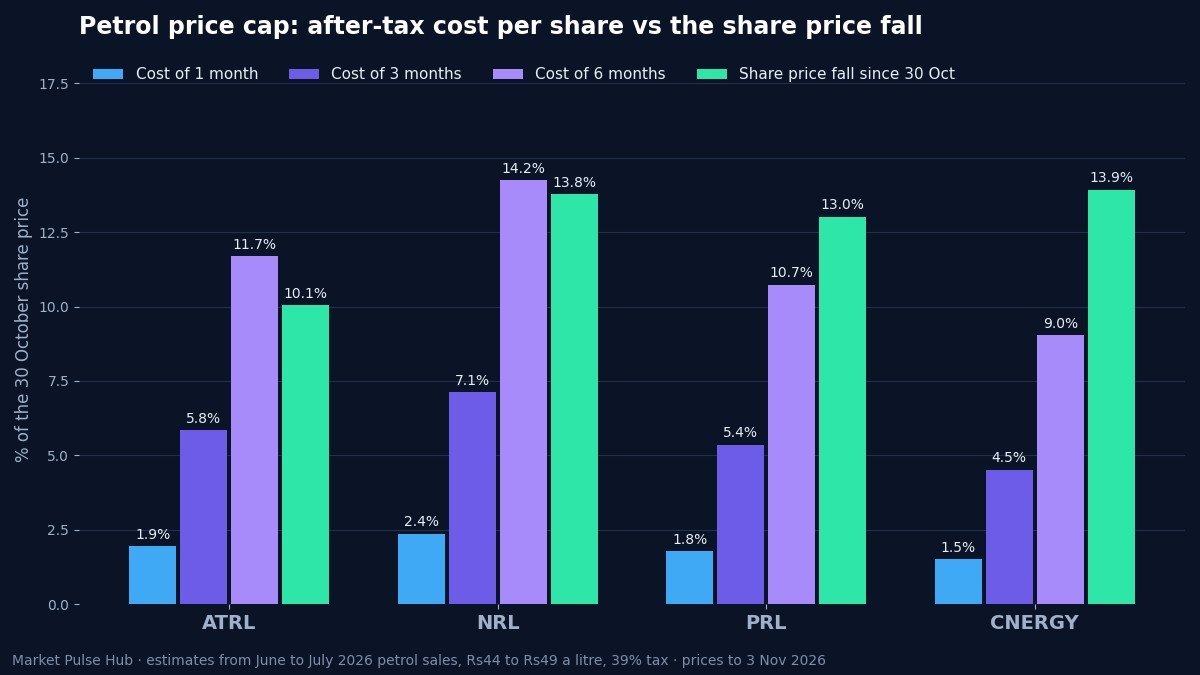
A simple way to value a temporary cost is to take the share price before the news and subtract the after-tax cost per share for as long as the measure lasts. The table shows that level for one, three, six and twelve months, using the 30 October closing prices. It is an illustration of the direct cost only, not a price target.
| Company | 30 Oct close | 3 Nov close | 1 month | 3 months | 6 months | 12 months | Fall equals months of cost |
|---|---|---|---|---|---|---|---|
| ATRL | 1,088.78 | 979.35 | 1,066 to 1,069 | 1,022 to 1,029 | 955 to 968 | 821 to 848 | 5 to 5.5 |
| NRL | 555.44 | 478.94 | 542 to 543 | 514 to 518 | 472 to 481 | 389 to 406 | 5.5 to 6 |
| PRL | 96.96 | 84.34 | 95.1 to 95.3 | 91.5 to 92.0 | 86.0 to 87.1 | 75.0 to 77.3 | 7 to 7.7 |
| CNERGY | 13.64 | 11.74 | 13.42 to 13.45 | 12.99 to 13.06 | 12.34 to 12.47 | 11.04 to 11.31 | 8.8 to 9.8 |
Three points stand out:
- The market has priced in far more than one month. The direct cost of 30 days is only about 1.5% to 2.5% of each pre-news share price, but the shares fell 10% to 14%. The fall already equals about five months of the cost for ATRL and NRL, about seven months for PRL and close to ten months for CNERGY.
- The extra fall is about policy risk. Refineries say the decision was taken without consulting them and conflicts with the refinery upgrade policy, which directs customs duty proceeds to dedicated refinery accounts. Investors are also pricing the chance of an extension; the petroleum minister said the government “would have to step in” if the situation worsens.
- A long extension would mean lower levels. If the cap ran for a full year with today’s volumes and premiums, the direct-cost levels in the 12-month column are below the 3 November prices for all four stocks. On the other hand, if it ends after 30 days, the direct cost is small and the gap between the share price fall and the actual cost could narrow.
Which refinery is most exposed
- ATRL has the largest cost per share (about Rs20 to Rs22 a month) because it is a big petrol seller with a small share count, and the customs duty part of the cost touches its upgrade funding.
- CNERGY runs largely on US crude, which yields more petrol; its management warned refining margins could turn negative. Its plant ran at only about 20% of capacity in July, so higher throughput would raise its petrol exposure.
- NRL loses about 9% to 10% of last quarter’s EPS each month and had posted a loss in the April to June 2026 quarter, so its earnings are the most volatile of the four.
- PRL has the smallest hit relative to its earnings (about 7% to 8% of last quarter’s EPS a month), but its upgrade project makes it sensitive to any change in refinery policy.
Limits of these estimates
- Volumes are June and July 2026 averages; monthly petrol sales move a lot (ATRL’s rose from 45,000 tons in June to 73,000 tons in July).
- The cost per litre shrinks if import premiums fall on their own, because the cap only takes the gap between current and pre-war premiums.
- The 39% tax rate, the litres-per-ton conversion and the share counts are approximations.
- The price table covers only the direct cost. It does not include a change in the P/E ratio investors are willing to pay, which is what policy risk usually changes.
What to watch next
- Whether the measure ends or is extended at the end of November.
- Any compensation, refund or change to the refinery upgrade policy funds.
- The levy amounts in OGRA’s price notifications.
- The October to December 2026 results, due by 1 March 2027.
You can follow each company’s Pulse Score, fair value and latest results on the Market Pulse Hub dashboard. The Pulse Score is our score out of 100 that sums up a company’s fundamentals, and fair value is our estimate of what the shares are worth; both are estimates, not predictions.
Frequently asked questions
What is the refinery petrol price cap?
For 30 days from 30 October 2026, refineries must price petrol using the premium, freight and customs duty of 7 March 2026 and pay the difference from the current import price into the petroleum levy account. It keeps the pump price about Rs15 a litre lower than it would otherwise be.
How much will the cap cost ATRL, NRL, PRL and CNERGY?
Our estimate of the monthly after-tax cost is about Rs2.1 to 2.4 billion for ATRL, Rs1.0 to 1.1 billion for NRL, Rs1.0 to 1.2 billion for PRL and Rs1.1 to 1.2 billion for CNERGY, or Rs20.1 to 22.4, Rs12.5 to 13.9, Rs1.64 to 1.83 and Rs0.19 to 0.22 a share.
Will refinery profits fall in the October to December quarter?
The cap alone takes about 7% to 13% of last quarter’s earnings per share for each month it applies. The reported profit also depends on refining margins, throughput and inventory, so the final result can differ.
Have refinery shares already priced in the cap?
The 10% to 14% fall since 30 October equals about five to ten months of the estimated direct cost, so the market appears to be pricing an extension or wider policy risk, not only one month.
Does the cap apply to diesel?
No. It covers petrol only. Refineries had separately agreed to cap their margin on high-speed diesel, first at $41.89 and then at $38 a barrel.
Sources: The Express Tribune (1 November 2026), The Express Tribune (3 November 2026), Pakistan Today (2 November 2026), and refinery sales data reported by Profit for July 2026 and June 2026. Company results are from PSX filings; share prices are exchange closes.
Want every refinery’s score, fair value and results in one place? Join the Market Pulse Hub waitlist.
Bilal, Market Pulse Hub
Figures are from company results, exchange data and our calculations up to 3 November 2026 and will change as new data arrives. This article is for education only and is not investment advice.