The price to book ratio (P/B) compares a company’s share price with the value of its net assets per share, known as book value. A P/B below 1 means you can buy the company’s assets, after paying off all its debts, for less than their value in the accounts. It is one of the oldest value-investing measures and is especially useful for banks, asset-heavy companies and companies that are making losses.
The P/B formula
P/B ratio = Share price ÷ Book value per share
Book value per share = (Total assets − Total liabilities) ÷ Number of shares
Book value is the same as shareholders’ equity: what would be left for shareholders if the company sold everything at the value in its balance sheet and repaid every liability.
Worked example: Oil & Gas Development Company (OGDC)
- Shareholders’ equity: Rs 1,519.55 bn, over 4.30 bn shares.
- Book value per share: about Rs 353.31.
- Share price on 30 October 2026: Rs 306.78.
- P/B = 306.78 ÷ 353.31 = 0.87x.
OGDC’s shares traded below the book value of its net assets. Part of the reason is that a large share of its assets are receivables from the gas and power chain (the circular debt), which investors value at less than their face value. Our guide to receivable days shows how large those balances are.
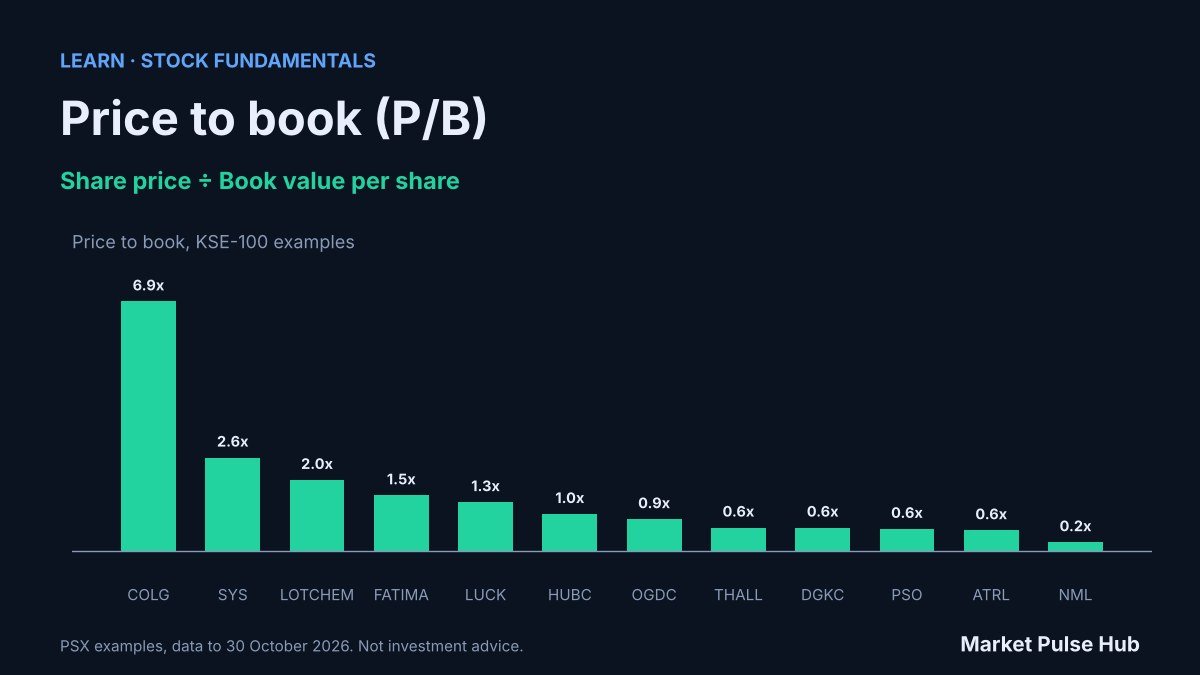
P/B ratios of KSE-100 companies
| Stock | Company | Share price | Book value per share | P/B |
|---|---|---|---|---|
| NML | Nishat Mills | Rs 123.00 | Rs 530.08 | 0.23x |
| ATRL | Attock Refinery | Rs 1,088.78 | Rs 1,932.21 | 0.56x |
| PSO | Pakistan State Oil Co. Ltd. Class I | Rs 355.44 | Rs 592.35 | 0.60x |
| DGKC | D.G. Khan Cement Co. | Rs 178.15 | Rs 280.25 | 0.64x |
| THALL | Thal | Rs 500.00 | Rs 786.12 | 0.64x |
| OGDC | Oil & Gas Development Co. | Rs 306.78 | Rs 353.31 | 0.87x |
| HUBC | Hub Power Co. | Rs 193.18 | Rs 191.33 | 1.01x |
| LUCK | Lucky Cement | Rs 391.38 | Rs 292.50 | 1.34x |
| FATIMA | Fatima Fertilizer Co. | Rs 134.56 | Rs 88.12 | 1.53x |
| LOTCHEM | Noventra | Rs 23.89 | Rs 12.24 | 1.95x |
| SYS | Systems | Rs 109.15 | Rs 42.49 | 2.57x |
| COLG | Colgate-Palmolive (Pakistan) | Rs 1,179.42 | Rs 171.40 | 6.88x |
Companies with heavy fixed assets and modest returns, such as Nishat Mills, Attock Refinery and PSO, trade well below book. Companies that earn high returns on small asset bases, such as Colgate-Palmolive and Systems Ltd, trade at several times book value, because their value lies in brands, people and know-how that the balance sheet does not record.
How to read P/B
- Pair it with ROE. A company that earns a high return on equity deserves a higher P/B. A useful rule: P/B ≈ ROE ÷ the return investors require. A company earning 25% on equity when investors want 15% can justify a P/B of about 1.7.
- Below 1 is not automatically cheap. It can mean the assets are worth less than the accounts say, or that the company earns too little on them.
- Most useful for banks. Bank assets are mostly loans and securities carried close to market value, so book value is a good guide to what a bank is worth.
- Least useful for service and consumer companies, whose most valuable assets are not on the balance sheet.
Our scoring also uses the Graham number test, P/E × P/B. Benjamin Graham suggested this should be under 22.5 for a defensive investment.
How to find P/B on Market Pulse Hub
P/B appears in each stock’s key figures and Valuation breakdown on the dashboard. In the screener, “P/B at most 1” lists every stock trading below book value.
Frequently asked questions
What is a good P/B ratio?
Below 1 can signal value, between 1 and 3 is common for healthy companies, and above 3 needs high, durable returns on equity to justify it. Always compare within the same sector.
Can book value be negative?
Yes. If accumulated losses exceed the capital put in, liabilities exceed assets and book value is negative. The P/B ratio is then meaningless and the company needs close scrutiny.
Why is P/B used for banks?
A bank’s assets are mostly financial and close to their market value, so its book value is a reliable measure of what it owns.
Related terms
- Return on equity (ROE)
- P/E ratio
- Intrinsic value and margin of safety
- All 20 stock fundamentals terms
Bilal, Market Pulse Hub
Figures are from company results and closing prices up to 30 October 2026 and will change as new results and prices arrive. Ratios are our calculations or come from our financial data, and other sources may show slightly different values because of different definitions or dates. This article is for education only and is not investment advice.