SIP in Pakistan stocks means putting the same amount of money into the market every month, whatever the price, instead of investing one large sum at a time you choose. It is popular because it is simple and it takes the guesswork out of timing. But does it actually work on the Pakistan Stock Exchange (PSX)? We tested it with real KSE-100 data up to 6 November 2026: Rs 10,000 a month over the last 5 years and the last 10 years, plus every 5-year window since 2013.
What a SIP is and how it works on PSX
SIP stands for systematic investment plan. You pick an amount you can afford every month, invest it on a fixed date, and keep going through good and bad markets. When prices are high your money buys fewer shares; when prices fall it buys more. Over time this averages out your purchase price, which is why it is often called rupee cost averaging.
In Pakistan there are two common ways to do it. You can buy shares or an exchange traded fund through your broker every month, or you can use the monthly investment plan offered by many mutual funds. Each route has different costs, minimums and paperwork, so check the details with your broker or the fund’s offering documents. Our guide to mutual funds vs stocks in Pakistan compares the two, and minimum investment on PSX explains how small you can start.
How we tested it
We used daily KSE-100 closing values from January 2013 to 6 November 2026. In our test, Rs 10,000 is invested at the close on the first trading day of every month, and the holding is valued at the KSE-100 close on 6 November 2026 (173,887 points).
Two points matter. First, PSX calculates the KSE-100 as a total return index, which means dividends and other corporate actions are adjusted in the index (PSX also publishes a price-only version called KSE100PR), according to the PSX indices page and its KSE-100 brochure. So the results include dividends. Second, the test ignores brokerage, CDC and other charges, taxes on dividends and capital gains, and the small tracking gap of any real fund. Real returns would be lower. See our guide to capital gains and dividend tax on PSX for the tax side.
SIP in Pakistan stocks: 5 and 10 year results
| Plan | Months | Put in | Value on 6 Nov 2026 | Gain | Annual return | Lump sum on day one, value now |
|---|---|---|---|---|---|---|
| 5 years, Nov 2021 to Oct 2026 | 60 | Rs 600,000 | Rs 1,568,478 | 161.4% | 39.4% | Rs 2,221,022 |
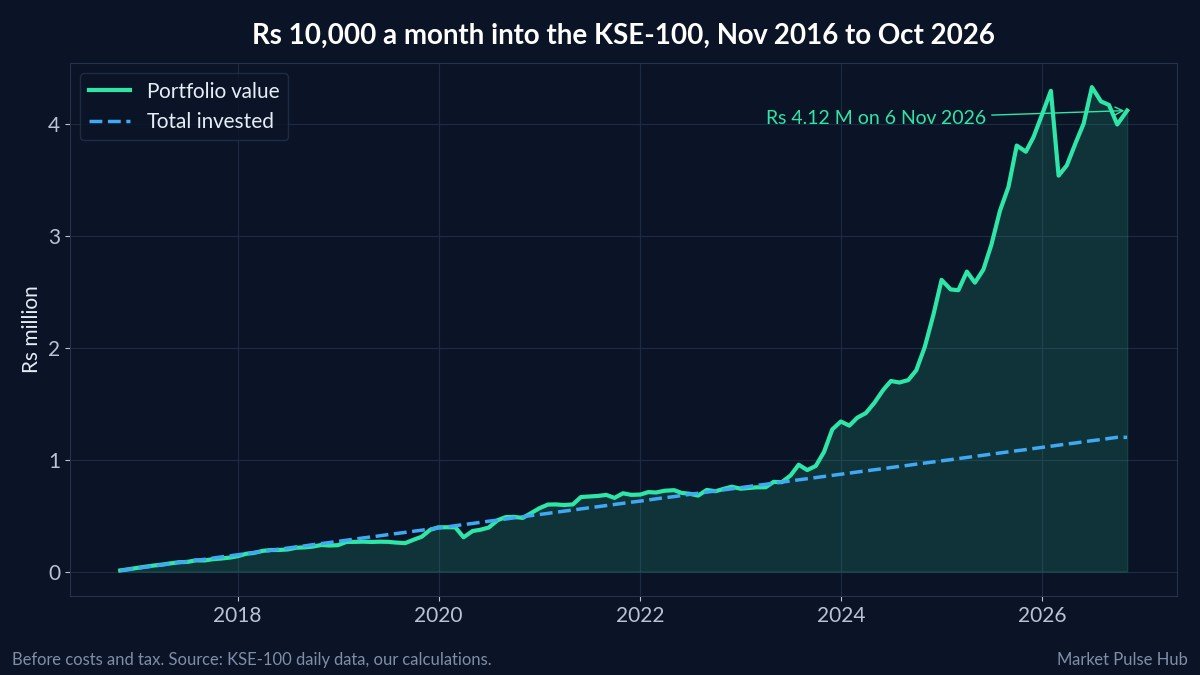
| 10 years, Nov 2016 to Oct 2026 | 120 | Rs 1,200,000 | Rs 4,120,951 | 243.4% | 23.3% | Rs 5,052,414 |
Both plans made money, and a lot of it. Rs 10,000 a month for ten years grew to about Rs 4.12 million on Rs 1.2 million put in. The annual return shown is money weighted (an internal rate of return), which takes into account that most of the money went in later.
Notice the last column. If you had invested the whole amount on day one, you would have ended with more in both periods, because the KSE-100 rose a lot over these years. When a market rises steadily, the earlier you invest, the better. That is not a failure of SIP: most people do not have Rs 1.2 million to invest on day one, and a SIP lets you invest from your salary as you earn it.
The hard part: years of going nowhere
The final number hides how the journey felt. Here is the 10-year plan year by year, valued on the first trading day of October each year.
| Date | Total put in | Portfolio value | Gain or loss |
|---|---|---|---|
| 2 October 2017 | Rs 120,000 | Rs 110,201 | -8.2% |
| 1 October 2018 | Rs 240,000 | Rs 223,143 | -7.0% |
| 1 October 2019 | Rs 360,000 | Rs 282,975 | -21.4% |
| 1 October 2020 | Rs 480,000 | Rs 488,509 | 1.8% |
| 1 October 2021 | Rs 600,000 | Rs 658,669 | 9.8% |
| 3 October 2022 | Rs 720,000 | Rs 718,049 | -0.3% |
| 2 October 2023 | Rs 840,000 | Rs 943,683 | 12.3% |
| 1 October 2024 | Rs 960,000 | Rs 1,798,812 | 87.4% |
| 1 October 2025 | Rs 1,080,000 | Rs 3,808,280 | 252.6% |
| 1 October 2026 | Rs 1,200,000 | Rs 3,996,535 | 233.0% |
| 6 November 2026 | Rs 1,200,000 | Rs 4,120,951 | 243.4% |
For almost seven years the plan was close to break-even or below it. Out of 121 monthly checks, the portfolio was worth less than the money put in on 43 of them, from July 2017 to as late as June 2023. The worst point came in September 2019, when Rs 350,000 put in was worth Rs 254,381, a loss of 27.3%. Almost all of the gain came from late 2023 onwards.
The 5-year plan had an easier ride. Its worst point was in August 2022, when Rs 100,000 put in was worth Rs 90,825, a loss of 9.2%.
This is the real lesson of SIP investing in Pakistan. The method only works if you keep paying in during the dull and painful years, because those are the months when your Rs 10,000 buys the most. Someone who stopped in 2019 would have locked in a loss and missed the recovery. Our history of KSE-100 returns by year shows how uneven those years were.
Every 5-year SIP since 2013
The last 5 and 10 years were unusually strong, so we also tested every 5-year plan we could: 107 plans, starting each month from January 2013 to November 2021. Each invests Rs 10,000 a month for 60 months and is valued on the first trading day after the last payment.
| Measure | Result |
|---|---|
| 5-year plans tested | 107 |
| Plans that ended with a loss | 14 |
| Median result | Rs 600,000 grew to about Rs 699,000 (16.5% total gain) |
| Worst plan | Started April 2015, valued 1 April 2020: Rs 600,000 worth about Rs 458,900 (23.5% loss) |
| Best plan | Started February 2021, valued 2 February 2026: Rs 600,000 worth about Rs 1,931,800 (3.22 times) |
Most 5-year plans made money, but the typical gain of about 16.5% over five years is far below the recent results, and 14 out of 107 lost money. The losing plans mostly started in 2014 and 2015, and ended in early 2020 when markets fell during the start of the COVID-19 pandemic. Five years is not always long enough. A plan that can run for ten years or more gives the market more time to recover from bad patches.
How to make a SIP work for you
- Choose an amount you can keep paying in a bad year. Missing payments in a falling market undoes the main benefit.
- Keep costs low. On small monthly amounts, a minimum brokerage fee can eat a big share of each purchase. Ask your broker how fees work on small orders, or compare with a fund’s charges.
- Diversify. An index fund or ETF spreads money across many companies. If you pick shares yourself, spread your monthly buys across several businesses and sectors.
- Keep an emergency fund outside the market. A SIP is for money you can leave for many years.
- Review once a year, not every day. Check that you are still on track and that the amount still fits your budget.
You can try your own numbers with the SIP calculator in the Calculators section of the Market Pulse Hub dashboard. Change the monthly amount, the period and the expected return to see how the final value changes, and remember that past returns are not a forecast.
Frequently asked questions
Does a SIP in Pakistan stocks guarantee a profit?
No. In our test, 14 of 107 five-year plans since 2013 ended with a loss, and even the strong 10-year plan was below the money put in for long stretches. A SIP reduces the risk of investing everything at a bad moment, but it does not remove market risk.
Is a lump sum better than a SIP?
In a market that rises over the period, a lump sum invested at the start usually ends with more, as it did in both our 5 and 10-year tests. But nobody knows in advance whether the next years will rise, and most people invest from monthly income anyway. A SIP also makes it easier to keep going when prices fall.
How much should I invest every month?
An amount you can keep paying for many years without touching your emergency savings. Many people start small and increase the amount when their income rises. Check the minimums and fees with your broker or fund before you start.
Do these results include dividends?
Yes, because PSX calculates the KSE-100 as a total return index. They do not include brokerage, CDC and other charges, or taxes on dividends and gains, so a real investor would earn less.
Which day of the month is best for a SIP?
Over long periods the day matters very little compared with staying invested. Pick a date shortly after your salary arrives so the payment happens automatically.
Want updates when we add new tools and data for PSX investors? Join the Market Pulse Hub waitlist.
Figures are from company results, exchange data and our calculations up to 6 November 2026 and will change as new data arrives. This article is for education only and is not investment advice.