PSX results dates follow a regular pattern: listed companies must publish their accounts within a fixed number of days after each quarter, half year and full year, so results arrive in waves known as results season. This guide explains the legal deadlines, shows how the latest season played out for the 263 companies we track, and what is due next, using the PSX announcements in our data up to 5 November 2026.
The deadlines for PSX results dates
The deadlines come from the Companies Act 2017 and the PSX rule book. The table summarises them with the official source for each. Rules can change, so check the latest version if you need certainty for a particular company.
| Accounts | Deadline | Notes | Source |
|---|---|---|---|
| First and third quarter | Within 30 days of the quarter end | Not audited | SECP: company accounts (Companies Act 2017, section 237) |
| Half year (second quarter) | Within 60 days of the half-year end | Subject to a limited scope review by the auditors | SECP: company accounts (section 237) |
| Annual audited accounts | Laid before the AGM, which must be held within 120 days of the year end | Annual report sent to shareholders and the PSX at least 21 days before the AGM | SECP: company accounts (section 223); PSX Rule Book chapter 5 |
| Announcing to the market | Immediately after the board meeting that approves the results | If the meeting ends outside the announcement system’s hours, results go out before the next day’s trading | PSX guidance notes, July 2023 |
The PSX rule book treats financial results as price-sensitive information, so companies must send them to the exchange and the SECP before sharing them with anyone else. Companies also post a notice of the board meeting in advance, which is often the first sign that results are coming. A company that fails to hold its AGM or file its annual audited accounts on time can face action by the exchange, which can include being moved to a separate segment of the market; the exact current rule is in the PSX Regulations.
Financial years on the PSX
The calendar depends on each company’s financial year. Of the 263 companies in our results data, 203 have a June year end, 54 a December year end, 4 a September year end and 2 a March year end. June is the most common, matching Pakistan’s July to June fiscal year. Every commercial bank in our data uses December, as do the insurers. December year-end KSE-100 members include banks such as HBL, MCB, UBL and MEBL, as well as FFC, EFERT, SYS and NESTLE.
This means the same calendar date can be a different period for different companies. The quarter to 30 September 2026 is the first quarter of the 2027 financial year for a June year-end company, but the third quarter of 2026 for a December year-end bank.
How the latest results season played out
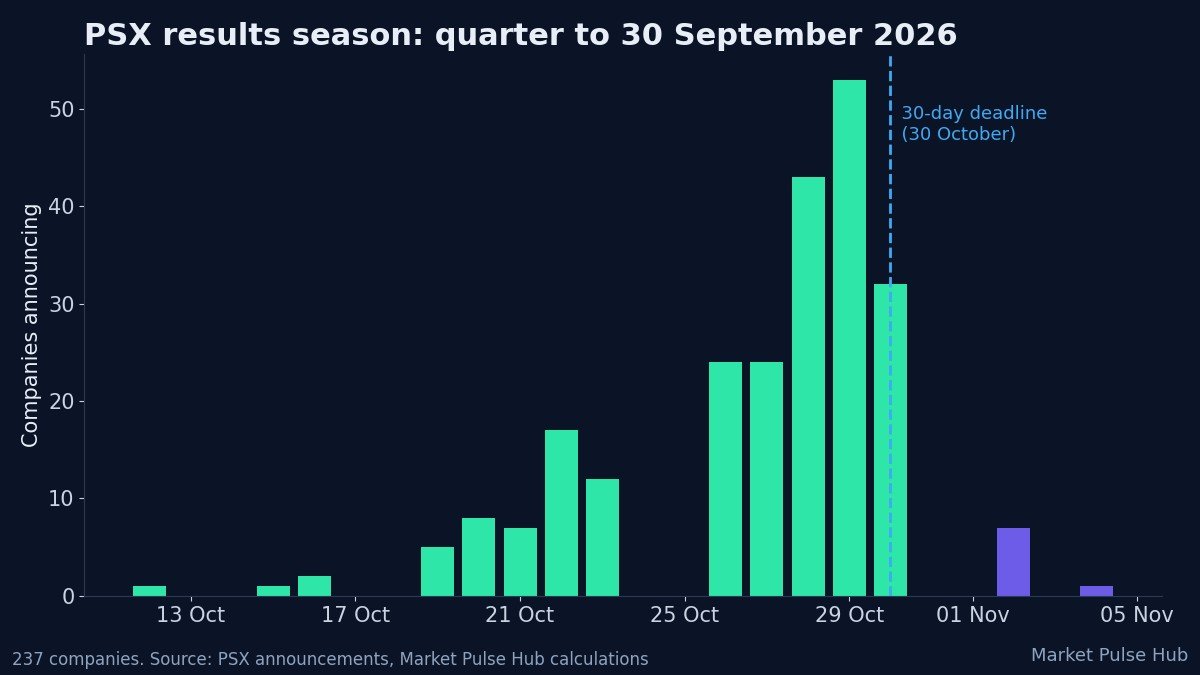
For the quarter to 30 September 2026, 237 of the companies in our data had announced results by 5 November 2026. The median company reported 28 days after the quarter end, and most left it to the last two weeks. The busiest day was 29 October 2026, with 53 announcements. 229 companies reported by 30 October, the 30-day deadline; the rest of the announcements in our data came in the first days of November, which can include companies with board meetings that ran late or figures that reached our data late.
| Week | Companies announcing | Share of the season |
|---|---|---|
| 12 to 16 October | 4 | 2% |
| 19 to 23 October | 49 | 21% |
| 26 to 30 October | 176 | 74% |
| 2 to 4 November | 8 | 3% |
The 90 KSE-100 companies in this group reported a median of 27 days after the quarter end, against 28 days for the other 147, so index members were only slightly earlier. Among the earliest were LOTCHEM (15 days), UBL (16 days) and EFERT (19 days). Our weekly PSX results round-up covers each week’s announcements.
What is due next
The table shows the next reporting period for the companies in our data and the deadline worked out from the rules above. The expected dates on our Results Calendar are estimates based on each company’s past timing.
| Next period | Deadline | Companies |
|---|---|---|
| Quarter to 30 September 2026 | 30 October 2026 | 17 |
| Half year to 30 September 2026 | 29 November 2026 | 1 |
| Full year to 30 September 2026 | 28 January 2027 | 3 |
| Quarter to 31 December 2026 | 30 January 2027 | 2 |
| Half year to 31 December 2026 | 1 March 2027 | 182 |
| Full year to 31 December 2026 | 30 April 2027 | 53 |
The first row counts companies whose results for the quarter to 30 September 2026 had not appeared in our data by 5 November 2026; some may have reported under a different period or may be late.
The next big wave is the half-year to 31 December 2026 for the 182 June year-end companies, due by 1 March 2027. The 53 December year-end companies, including the banks, will publish full-year 2026 results, which must come before their AGMs; those meetings must be held by 30 April 2027. Companies with a September year end, such as several sugar mills, and Honda Atlas Cars (HCAR), whose half year ended on 30 September, report on their own timetable.
Why results dates matter to investors
- Dividends: many PSX companies announce cash dividends with their results, together with the book closure dates. Knowing when results are due tells you when a dividend decision is likely.
- Price moves: share prices can move sharply on the day results are announced, so some investors prefer not to buy or sell just before.
- Fresh ratios: P/E, ROE and fair value estimates are updated as new results arrive, so the figures for a company can change in results season.
- Late filers: a company that regularly misses deadlines is a warning sign about its governance.
The Results Calendar tab on the free Market Pulse Hub dashboard lists which companies are due to report in the next two weeks, which have already called board meetings and which are past their deadline. To understand the figures once they arrive, see our step-by-step guide to earnings per share and our highest dividend yield stocks list.
Frequently asked questions
When do PSX companies announce quarterly results?
First and third quarter results must be published within 30 days of the quarter end, and half-yearly results within 60 days. Most companies announce in the last two weeks before the deadline.
When are annual results announced?
Annual audited accounts must be laid before the annual general meeting, which has to be held within 120 days of the financial year end. The annual report must reach shareholders and the PSX at least 21 days before the meeting.
Where are PSX results announced?
Companies send their results to the exchange immediately after the board meeting, and they appear in the company announcements on the PSX data portal (dps.psx.com.pk). The Market Pulse Hub dashboard collects them in its Results Calendar.
Why do banks report on different dates from most companies?
Most Pakistani banks have a December financial year end, while most other listed companies use June. The quarter to September is the third quarter for a bank but the first quarter for a June year-end company.
What happens if a company misses its results deadline?
Missing a legal deadline is a breach of the Companies Act and the PSX rules, and the exchange can take action, which can include moving a company to a separate segment of the market or suspending trading in serious cases. Check the PSX notices for any action against a specific company.
Track upcoming results on the free Market Pulse Hub dashboard, and join the waitlist to get new tools and reports first.
Bilal, Market Pulse Hub
Figures are from company results, exchange data and our calculations up to 5 November 2026 and will change as new data arrives. This article is for education only and is not investment advice.