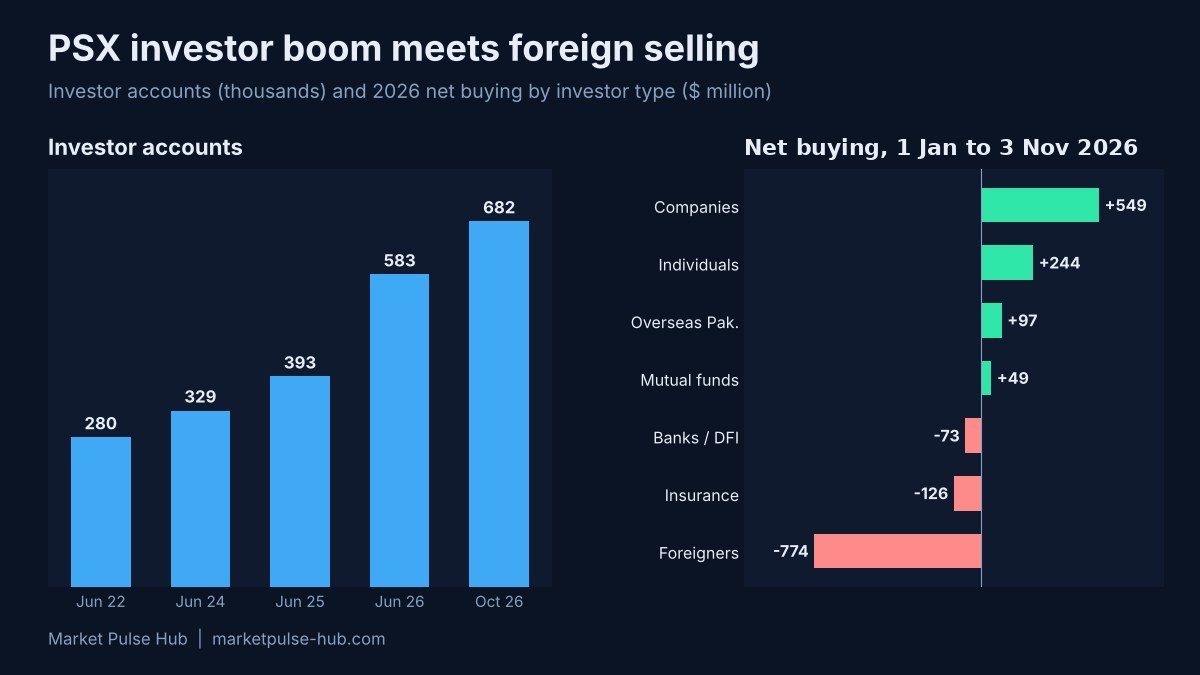
Pakistan’s stock market investor base has passed 683,000, according to the Securities and Exchange Commission of Pakistan (SECP), after a record 25,747 people opened accounts in October 2026 alone. More people joined PSX in the first ten months of 2026 than in the previous four years combined. In this analysis we look at what this growth means for the Pakistan Stock Exchange, what the smart money data says about who is actually buying and selling, and how a bigger investor base could change the KSE-100’s P/E ratio, index level and outlook.
The numbers behind the headline
| Date | Investor accounts | Change |
|---|---|---|
| June 2022 | 279,522 | – |
| June 2024 | 329,292 | +18% in two years |
| June 2025 | 392,775 | +19% |
| June 2026 | 583,052 | +48%, a record year |
| October 2026 | 681,965 | +56% on a year earlier |
| Early November 2026 | more than 683,000 | – |
- Record growth. Investor accounts rose 48% in the year to June 2026, the fastest growth on record, and were up 56% on a year earlier by October.
- Young investors. About 85% of new investors are Gen Z and millennials. In the first half of 2026, 45% of new accounts belonged to people aged 18 to 30 and 41% to people aged 31 to 45.
- Big cities lead. Karachi made up 25% of new accounts, Lahore 16% and Islamabad and Rawalpindi 13%.
- Still a small share of the population. The SECP says fewer than 1% of Pakistanis invest in the stock market, and has set a target of 2.5 million investors within three years.
Why so many people are joining
Three things have come together. First, returns: the KSE-100 rose strongly in 2024 and 2025, and many savers moved money from bank deposits and property into shares as interest rates came down. Second, it is now much easier to open an account. The SECP has raised the limit on the simple Sahulat account from Rs1 million to Rs3 million, introduced IBAN-based verification, removed duplicate checks for accounts opened through banks and digital banks, and set deadlines of one working day for Sahulat accounts and two days for standard accounts. Minors can now invest through a guardian’s account, and a digital onboarding app is being prepared. Third, a new generation of investors is learning about the market on their phones and social media.
What the smart money data shows
Account numbers show how many people have joined, but not how much money they bring. For that we look at the daily clearing data that shows net buying and selling by each type of investor, which Market Pulse Hub tracks on its dashboard. This is often called smart money data because it shows what large investors such as foreign funds, local mutual funds, banks and insurers are doing.
| Investor type | 1 Jan to 3 Nov 2026 | 1 Jul to 3 Nov 2026 | October 2026 |
|---|---|---|---|
| Foreign investors | -774 | -115 | -82 |
| Local companies | +549 | +47 | +16 |
| Individuals | +244 | +138 | +43 |
| Overseas Pakistanis | +97 | +36 | +11 |
| Other organisations | +61 | +53 | +52 |
| Mutual funds | +49 | -105 | -44 |
| Banks and DFIs | -73 | -24 | +16 |
| Insurance companies | -126 | -16 | -10 |
| Broker proprietary trading | -29 | -15 | -2 |
The picture is clear. Foreign investors have been heavy sellers, taking about $775 million out of PSX in 2026 so far, with the biggest exits in February and June. Local investors absorbed all of it. Local companies bought about $549 million and individuals about $244 million, with overseas Pakistanis adding another $97 million.
Individuals are the steadiest buyers. They have been net buyers in every month since July, which matches the rush of new accounts. Mutual funds, on the other hand, have turned sellers since July, which suggests some investors are taking money out of equity funds even as others open their own accounts. Banks and insurance companies have mostly been sellers.
| Month | Foreign | Individuals | Mutual funds | Local companies |
|---|---|---|---|---|
| Jan 2026 | -67 | +24 | +95 | +44 |
| Feb 2026 | -281 | 0 | +45 | +221 |
| Mar 2026 | -72 | +48 | -56 | -3 |
| Apr 2026 | -15 | +59 | +22 | +15 |
| May 2026 | -21 | +1 | 0 | -4 |
| Jun 2026 | -204 | -26 | +48 | +229 |
| Jul 2026 | +24 | +24 | -30 | -14 |
| Aug 2026 | -30 | +32 | +9 | +20 |
| Sep 2026 | -23 | +37 | -43 | +20 |
| Oct 2026 | -82 | +43 | -44 | +16 |
Two points stand out. First, individual buying of about $40 million a month is real but still small next to foreign selling that can reach $200 million or more in a bad month. A bigger investor base cushions the market, but it does not yet replace foreign money. Second, the market has held up well despite the selling: the KSE-100 is only about 2% lower this year even after foreigners sold $775 million.
Where the KSE-100 stands today
| Measure | KSE-100 today |
|---|---|
| Index level (4 Nov 2026, intraday) | 170,549 |
| Change in 2026 so far | −2.0% |
| Change over one year | +4.8% |
| Below record high of 189,167 (23 Jan 2026) | −9.8% |
| Fall from January high to March low | −22.6% |
| P/E on last 12 months’ earnings | about 7.0x |
| Dividend yield | about 6.5% |
| Market value of the 100 stocks | about Rs15.1 trillion |
| Average Pulse Score (weighted by size) | 67 out of 100 |
| Average daily volume in 2026 | about 325 million shares (2024: 252 million) |
The KSE-100 trades at about 7 times the last 12 months’ earnings with a dividend yield of about 6.5%. That is cheap by most measures. It means investors are paying Rs7 for every Rs1 of yearly profit, and the companies in the index pay out a large share of that profit as dividends. The index is about 10% below its January record and fell about 23% between January and March before recovering.
For a closer look at how we score individual companies, see our guide to reading a stock page, and for the market’s most profitable names see our list of the most profitable companies on PSX.
How a bigger investor base can lift the P/E ratio
A stock market’s level depends on two things: how much its companies earn, and how much investors are willing to pay for those earnings (the P/E ratio). New investors do not change company profits directly, but they can change the P/E in several ways:
- More buyers for the same shares. PSX has a small free float, so a steady flow of new local money can push prices up even if profits stay the same.
- Less dependence on foreign money. Pakistan has traded at a low P/E partly because foreign investors demand a big discount for country risk. A large, stable local investor base reduces that dependence, as it has in India.
- Better liquidity. Average daily volume is up about 30% from 2024. More trading makes it easier for big investors to buy and sell, which supports higher valuations.
- More listings. A bigger pool of investors makes it easier for companies to raise money through new listings, which deepens the market over time.
| P/E the market pays | Index level with today’s earnings | Index level if earnings grow 10% |
|---|---|---|
| 6x | about 145,800 | about 160,300 |
| 7x (today) | about 170,100 | about 187,100 |
| 8x | about 194,400 | about 213,800 |
| 9x | about 218,700 | about 240,500 |
| 10x | about 242,900 | about 267,200 |
Each extra point of P/E is worth about 24,000 index points at today’s earnings. If the market moved from 7 times to 8 times earnings and profits grew 10%, the KSE-100 would be around 214,000. If the P/E fell back to 6 times with no growth, it would be around 146,000.
Future outlook
| Scenario (next 12 months) | What happens | P/E and earnings | KSE-100 level |
|---|---|---|---|
| Bear case | Foreign selling continues, rates rise, new investors stop coming | 6x, flat earnings | about 146,000 |
| Base case | Steady inflow of new local investors, earnings grow with the economy | 7.5x, earnings +8% | about 197,000 |
| Bull case | Local funds and retail keep buying, foreign selling stops, rates fall | 9x, earnings +12% | about 245,000 |
Our base case assumes new local investors keep coming at a steady pace, foreign selling slows, and company profits grow roughly in line with the economy. The bull case needs lower interest rates as well, because rates are the main competitor for savers’ money; see our guide to how SBP rate changes move the KSE-100. These ranges show how sensitive the index is to valuation, not where it will go.
Risks of a retail-driven market
- Herd behaviour. New investors tend to buy after prices rise and sell after they fall, which can make swings bigger. The 23% fall between January and March 2026 is a reminder.
- Borrowed money. Investors who buy with borrowed money can be forced to sell in a downturn, which deepens falls.
- Small amounts per account. Most new accounts are small, so the money they bring is limited compared with institutional flows.
- Foreign selling. If foreign investors keep selling and local buying slows, the index could fall even with a growing investor base.
- Interest rates and the economy. Higher rates or a setback in Pakistan’s economic programme would cut both earnings and P/E.
For new investors, the lesson is to look at the value of what they buy, not just the price trend. Our explainer on fair value and margin of safety is a good place to start.
What to watch next
- Monthly new investor numbers, especially whether they stay above 20,000 a month.
- Monthly net buying by individuals and mutual funds against foreign selling.
- Mutual fund flows, to see whether the recent selling reverses.
- The State Bank of Pakistan’s interest rate decisions.
- Company results for October to December 2026, which will decide whether earnings keep growing.
You can follow daily investor flows, the KSE-100 and every stock’s Pulse Score on the Market Pulse Hub dashboard.
Frequently asked questions
How many investors does PSX have?
More than 683,000 according to the SECP, up from about 393,000 in June 2025. A record 25,747 new investors joined in October 2026.
Who is buying PSX shares in 2026?
Local companies, individuals and overseas Pakistanis have been the main buyers. Foreign investors have sold about $775 million so far this year, and banks and insurance companies have also been sellers.
What is the KSE-100 P/E ratio?
About 7 times the last 12 months’ earnings, with a dividend yield of about 6.5%, based on Market Pulse Hub calculations for the index’s 100 stocks.
Can more investors push the KSE-100 higher?
They can help by adding steady local buying and liquidity, which can lift the P/E ratio over time. Each extra point of P/E is worth about 24,000 index points at today’s earnings. But earnings, interest rates and foreign flows matter just as much.
Is a market with many new investors riskier?
It can be more volatile in the short term, because new investors often react to price moves. Over time, a broader investor base usually makes a market more stable and less dependent on foreign money.
Want to follow investor flows and scores as they change? Join the Market Pulse Hub waitlist.
Bilal, Market Pulse Hub
Figures are from SECP and official data reported in the press, PSX, daily clearing data and our calculations up to 4 November 2026, and will change as new data arrives. This article is for education only and is not investment advice.