Artificial intelligence is changing how software is built and sold, and investors are asking what it means for Pakistan’s listed technology companies. Will AI tools replace the programmers that firms like Systems Ltd (SYS) sell to foreign clients, or will they bring in more work? And can NETSOL Technologies (NETSOL) use AI to make its leasing software more valuable? This analysis looks at the latest results, what management says, the export numbers and each stock’s Pulse Score and fair value, with data up to 3 November 2026.
The short answer
So far AI is helping the large PSX tech companies and hurting small, low-end service firms. Systems is selling AI projects and winning bigger deals, especially in the Middle East. NETSOL owns its software, so AI is a chance to sell upgrades and cut its own costs. The main risks are a change in how clients pay for services, new AI-first rivals, the rupee and wage costs.
What is happening in Pakistan’s IT industry
Pakistan’s IT exports hit a record in the year to June 2026, up about 21%. But under the headline the mix is changing. Industry body P@SHA reports that entry-level hiring at major tech firms has fallen by about 25%, and press reports describe some small software houses cutting most of their delivery staff after automating routine coding, testing and support. Basic writing and translation freelance work is also shrinking as clients use AI tools.
| Measure | FY2024-25 | FY2025-26 | Change |
|---|---|---|---|
| IT and IT-enabled services exports | $3.81bn | $4.6bn | +21% |
| Government target for FY2025-26 | – | $5.0bn | missed by about $0.4bn |
| Freelancers’ share of exports | – | about a quarter | – |
The pattern is that work is moving up the value chain. Firms that own software products or can deliver full AI projects are getting more work, while firms that rent out programmers by the hour are losing it.
| Business type | How AI affects it | Examples on PSX |
|---|---|---|
| Large services firms that sell AI projects | More and bigger deals, but fewer billable hours per project | Systems |
| Software product companies | AI can be sold as an upgrade to existing clients and cuts their own costs | NETSOL |
| Small outsourcing and staffing firms | Routine coding, testing and support is being automated | many unlisted firms |
| Industrial automation and digital media | Mixed: depends on clients’ spending | Avanceon, Octopus Digital |
Systems Ltd: more AI work, but a change in pricing to manage
Systems is the largest listed tech company in Pakistan, with a market value of about Rs168 billion. It builds and runs software for banks, telecom companies, governments and retailers in North America, Europe, the Middle East and Asia, and has been adding new delivery centres in Egypt and Malaysia.
| Measure | Jan to Jun 2026 | Jan to Jun 2025 | Change |
|---|---|---|---|
| Revenue | Rs49.7bn | Rs36.7bn | +35% |
| Gross profit | Rs12.7bn | Rs9.3bn | +37% |
| Operating profit | Rs6.5bn | Rs5.1bn | +29% |
| Profit after tax | Rs6.05bn | Rs5.15bn | +17% |
| Operating margin | 13.2% | 13.8% | slightly lower |
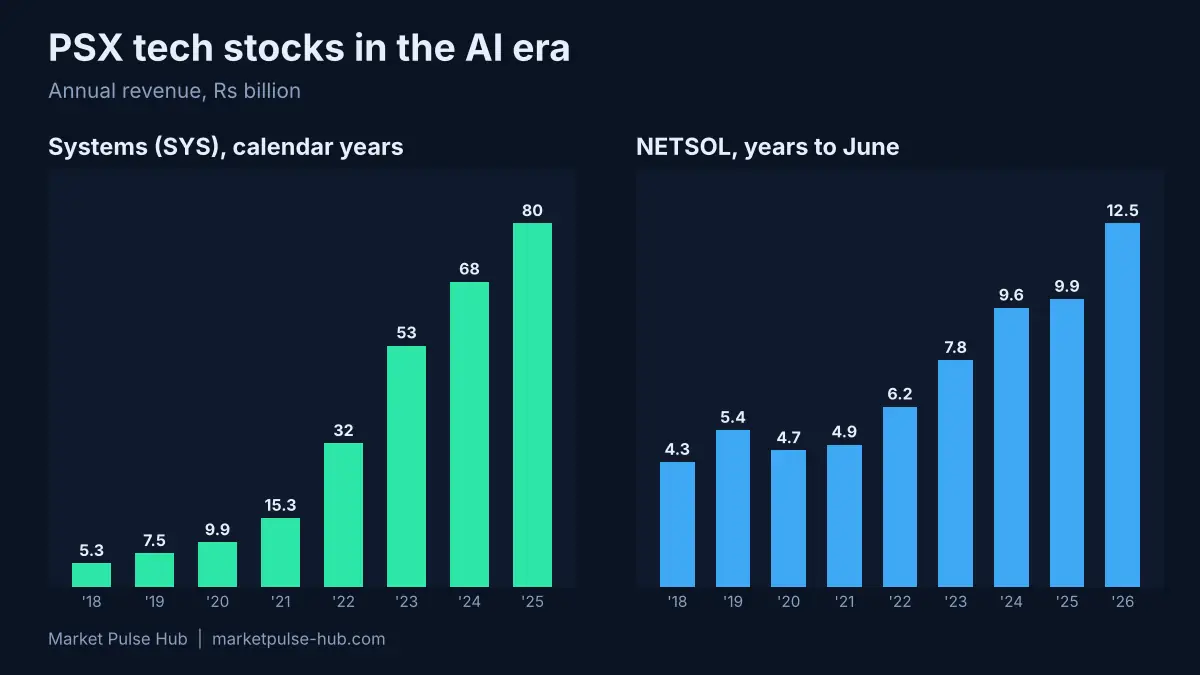
Revenue rose 35% in the first half of 2026, helped by acquisitions and what the company called AI-led deal growth in the Middle East and Asia. Management says AI is increasing demand for services, that productivity gains are leading to larger deal sizes, and that its customers want to make AI a growth engine. Government plans in the Gulf to move a large share of public services onto AI systems are a new source of work.
| Measure | Jul to Sep 2026 | Jul to Sep 2025 | Change |
|---|---|---|---|
| Net profit | Rs3.03bn | Rs2.79bn | +9% |
| Net profit, Jan to Sep | Rs9.08bn | Rs7.94bn | +14% |
| Total debt (end of quarter) | Rs12.4bn | Rs2.1bn | higher after acquisitions |
Profit growth was slower than revenue growth. About 80% of Systems’ costs are staff, wages rose by more than 12%, and a currency loss replaced last year’s gain. Debt has also gone up to pay for acquisitions, though at 0.19 times equity it is still low.
The main AI risk for Systems is pricing. Services companies have traditionally charged by the hour or by the number of people on a project. If AI lets one engineer do the work of three, clients will ask to pay less. Systems can protect itself by charging for results and keeping the savings, but the move could hurt margins for a while. Revenue per employee and operating margin are the numbers that will show whether it is working.
NETSOL: AI as an upgrade to software it already owns
NETSOL sells software that banks and car finance companies use to run their leasing and lending businesses, mainly in Asia, Europe and the US. Its main platform is called Transcend. NETSOL Technologies Limited, the PSX-listed company, is the Lahore-based arm of a US-listed parent and does most of the group’s development work.
| Year to June | Revenue | Net profit | EPS (Rs) |
|---|---|---|---|
| FY2022 | Rs6.2bn | Rs0.87bn | 9.72 |
| FY2023 | Rs7.8bn | Rs1.04bn | 11.79 |
| FY2024 | Rs9.6bn | Rs1.20bn | 13.59 |
| FY2025 | Rs9.9bn | Rs1.39bn | 15.74 |
| FY2026 | Rs12.5bn | Rs2.35bn | 27.01 |
Results have improved sharply. Revenue rose 26% to Rs12.5 billion in the year to June 2026 and profit rose 70% to Rs2.35 billion. The US parent reported record revenue, higher margins and guidance of 13% to 16% revenue growth for the year to June 2027, and says it will keep building AI into its products and its own delivery work.
NETSOL’s position is different from Systems’. Its clients pay for licences, subscriptions and support, not hours, and changing core lending software is slow and risky for a bank. That gives NETSOL time to add AI features and charge for them, and AI tools can lower its own development costs. The risk is that it has not yet named specific AI products, and newer, AI-first software firms could make lending platforms cheaper to build and sell.
Profit has been uneven from quarter to quarter, partly because of currency moves and the timing of large licence deals, and free cash flow over the last 12 months was negative. NETSOL holds about Rs5.9 billion in cash, more than half its market value, and has little debt.
How AI is hitting software services companies worldwide
Outside Pakistan, 2026 has been a hard year for listed IT services companies. The fear is simple: if AI can write code, test software and handle support tickets, clients will need fewer paid hours from outsourcing firms. That fear has shown up in both results and share prices.
- Growth has slowed to low single digits. India’s biggest firms, TCS, Infosys, HCLTech and Wipro, grew only about 2% to 3% in constant currency in the latest quarter, and most expect 0% to 4% growth this year. Accenture cut its revenue growth outlook for the year to August 2026 to 3% to 4%.
- AI is lowering prices for routine work. Brokers estimate that AI will cut traditional IT services revenue by about 2% to 3.5% a year for the next two to three years, as work such as application maintenance and back-office processing gets cheaper. New AI work is growing, but not yet fast enough to fill the gap.
- Hiring has turned down. TCS ended its year to March 2026 with about 23,500 fewer employees, while hiring for AI roles is still rising.
- Share prices fell hard. India’s IT index fell about 29% in the first half of 2026, one of its worst starts in two decades. Accenture had its worst one-day fall on record in June, and EPAM lost about two-thirds of its value from its January high.
- AI revenue is real but still small. TCS says it earns more than $2.3 billion a year from AI services, about 6% of revenue, and HCLTech more than $620 million a year.
| Company | Latest revenue growth | Share price move | P/E (approx.) |
|---|---|---|---|
| Accenture (US) | +6% in Mar to May 2026; full-year outlook cut to 3% to 4% | fell 18% in one day in June; under half its 52-week high | about 10x |
| Cognizant (US) | +5.8% in Jan to Mar 2026 | hit a 52-week low in June | about 9x |
| EPAM (US) | +7.6% in Jan to Mar 2026; outlook cut to 4% to 6.5% | down about two-thirds from its January high | about 11x |
| TCS (India) | +4.6% in the year to March 2026 | Indian IT index down about 29% in Jan to Jun 2026 | about 18x |
| Infosys (India) | +9.6% in the year to March 2026 | same index fall | – |
| Systems (PSX) | +35% in Jan to Jun 2026 | 37% below its 52-week high | 13.8x |
| NETSOL (PSX) | +26% in the year to June 2026 | 23% below its 52-week high | 3.8x |
How PSX tech companies compare
PSX tech companies are growing much faster than the global leaders. Systems grew revenue 35% in the first half of 2026 and NETSOL 26% in its latest year, while most global peers grew less than 10%. Part of that is size: Systems is a small fraction of Accenture or TCS, and acquisitions added to its growth. But there are also real differences.
- Lower cost base. Pakistani engineers cost less than those in the US, Europe or even India, so clients looking to save money can still find value in moving work to Pakistan, even as AI cuts the hours needed.
- Different markets. Indian firms earn about 60% of their revenue in the US, where clients cut spending first. Systems is growing fastest in the Gulf and Asia, where governments and big companies are spending heavily on AI.
- Product versus hours. NETSOL sells software rather than hours, which is the part of the industry least exposed to AI price cuts, much like global software product companies rather than outsourcers.
- Same pricing risk. The 2% to 3.5% yearly price pressure that global firms face will reach Systems too. Its margins slipped slightly in the first half, and that is the first number to watch.
- Valuations already fell. Systems trades at about 14 times earnings, between the 9x to 11x of Accenture, Cognizant and EPAM and the 18x of TCS. NETSOL, at about 4 times earnings, is far cheaper than any global peer, which reflects its small size, uneven profit and low trading volume as well as AI fears.
| Global IT services | PSX tech companies | |
|---|---|---|
| Revenue growth | Low single digits | 20% to 35% |
| Main AI effect so far | Clients spend less on routine work | More AI project work, mostly in the Middle East and Asia |
| Cost of an engineer | High (US, Europe, India) | Lower, so price cuts hurt less |
| Exposure to US clients | High: about 60% for Indian firms | Lower and spread across regions |
| Valuation | Fell to about 9x to 18x earnings | Systems about 14x, NETSOL about 4x |
| Currency | Weaker rupee helped Indian firms | Rupee was slightly stronger, which cut Systems’ profit growth |
In short, PSX tech companies have so far avoided the slowdown hitting global IT services, but they are not immune to it. If the global pattern of slower growth and lower prices reaches Pakistan, Systems would feel it more than NETSOL.
Scores and valuation
The Pulse Score is our score out of 100 that sums up a company’s growth, stability, valuation, working capital and cash flow; fair value is our estimate of what the shares are worth from earnings and cash flow. Both are estimates, not predictions. See our guide to reading a stock page.
| Measure | Systems (SYS) | NETSOL |
|---|---|---|
| Share price (3 Nov 2026) | Rs109.47 | Rs114.42 |
| Below 52-week high | 37% | 23% |
| Pulse Score | 59 / 100 | 65 / 100 |
| Fair value estimate | about Rs157 | about Rs561, see note |
| P/E (last 12 months) | 13.8x | 3.8x |
| EV / EBITDA | 9.6x | 2.9x |
| Price to book | 2.6x | 0.7x |
| Dividend yield | 1.8% | 1.3% |
| Return on equity | 18.8% | 19.2% |
| Net margin | 12.2% | 20.5% |
| Debt to equity | 0.19x | 0.17x |
| Sales growth a year, 5 years | 52% | 20% |
| Free cash flow / sales | 9.1% | −3.1% |
| Market value | Rs168bn | Rs10.3bn |
Systems scores well on growth and balance sheet strength, with sales growing about 52% a year over five years and very little debt. It loses points on valuation measures such as price to book and dividend yield. The shares are 37% below their 52-week high, and our fair value estimate of about Rs157 is about 44% above the current price.
NETSOL looks very cheap on its latest profit, at under 4 times earnings and below its book value, which is why our fair value estimate of about Rs561 is almost five times the Rs114 share price. We would treat that figure with caution: it is based on a year in which profit rose 70%, and NETSOL’s profit has swung widely in the past. Weak free cash flow is the main reason it does not score higher. For more on how to read these gaps, see our explainer on fair value and margin of safety.
Other PSX tech names
Smaller listed tech companies look less attractive on our fair value estimates. Avanceon works on industrial automation, Octopus Digital on digital and automation software for businesses, and TRG Pakistan mainly holds stakes in overseas customer-service and AI businesses.
| Stock | Price | Pulse Score | Fair value estimate |
|---|---|---|---|
| Avanceon (AVN) | Rs24.07 | 46 / 100 | about Rs25 |
| Octopus Digital (OCTOPUS) | Rs25.58 | 60 / 100 | about Rs11 |
| TRG Pakistan (TRG) | Rs51.47 | 29 / 100 | about Rs43 |
Scenarios
| What happens | Systems | NETSOL |
|---|---|---|
| AI demand keeps growing, pricing holds | Revenue and profit keep growing fast | More upgrades and new deals |
| Clients pay for results instead of hours | Must re-price; margins at risk for a while | Little effect: it sells licences and subscriptions |
| New AI-first rivals copy their products | More competition for projects | Pressure on prices and deal wins |
| Rupee strengthens sharply | Profit growth slows | Profit growth slows |
Risks to watch
- Pricing: clients asking to pay less per project as AI raises productivity.
- Competition: AI lowers the cost of building software, which helps new rivals.
- The rupee: both companies earn mostly in foreign currency, so a stronger rupee lowers their profit in rupees. A currency loss already slowed Systems’ profit growth this year.
- Wages: staff costs are most of Systems’ costs and rose more than 12%.
- Client spending: a slowdown in US or Gulf technology budgets would cut new deals. The interest rate outlook also affects how the market values growth stocks; see our guide to how SBP rate changes move stocks.
What to watch next
- Systems’ full-year 2026 results and its revenue per employee and margins.
- NETSOL’s quarterly results and any named AI products or large Transcend deals.
- Monthly IT export figures from the State Bank of Pakistan.
- Any change in how big clients buy services, such as fixed-price or results-based contracts.
Live scores, fair value and results for both companies are on the Systems and NETSOL stock pages and the Market Pulse Hub dashboard. For how they compare with other high-return companies, see our list of the most profitable companies on PSX.
Frequently asked questions
Will AI hurt Systems Ltd?
So far it has helped: Systems says AI is bringing in bigger deals, and revenue rose 35% in the first half of 2026. The risk is that clients pay less per project as AI makes engineers more productive, which could squeeze margins if Systems does not change how it charges.
Is NETSOL an AI stock?
Not yet in a big way. NETSOL sells leasing and lending software and says it is building AI into its products and its own work, but it has not named specific AI products. AI is more of an upgrade opportunity for its existing clients.
Which PSX tech stock benefits most from AI?
Systems has the clearest link today because it sells AI projects. NETSOL could benefit more slowly by selling AI features to clients who already use its software. Small outsourcing firms are the most at risk.
Why does NETSOL look so cheap?
Its share price is under 4 times last year’s profit and below its book value. Profit rose 70% in the year to June 2026, but NETSOL’s profit has been uneven in the past and its free cash flow was negative, so the market is cautious about whether that level will last.
How are global IT services stocks doing compared with PSX tech stocks?
Global IT services firms such as Accenture, TCS and Infosys are growing only in low single digits, and their shares fell sharply in 2026 on fears that AI will cut routine work. Systems and NETSOL are still growing 20% to 35% a year, helped by lower costs and work in the Gulf and Asia, but their shares have also fallen from their highs.
Do Pakistan’s IT exports still grow despite AI?
Yes. They grew about 21% to a record in the year to June 2026, though they missed the government’s $5 billion target and entry-level hiring has fallen.
Want to follow these scores and results as they change? Join the Market Pulse Hub waitlist.
Bilal, Market Pulse Hub
Figures are from company results, State Bank of Pakistan data, press reports and our calculations up to 3 November 2026 and will change as new data arrives. This article is for education only and is not investment advice.