Millat Tractors electric bikes became a talking point in 2026 when Millat Tractors (MTL), Pakistan’s largest tractor maker, said a subsidiary would assemble and sell electric bikes with a Chinese partner. Investors want to know if this changes the investment case: will it lift growth, put the dividend at risk, or move the stock’s score? This analysis looks at the e-bike plan against the size of Millat’s tractor business, its record of profits and dividends, and its current Pulse Score and fair value, using company filings and exchange data up to 3 November 2026.
What Millat has announced on electric bikes
The plan moved in three steps. In early May 2026 Millat told the exchange that a group company was studying electric motorcycle production, at a preliminary stage. A few days later it said its subsidiary had signed a memorandum of understanding with a leading Chinese electric bike maker to assemble, make and market e-bikes in Pakistan, in line with the National Electric Vehicle Policy 2025-30. In June shareholders approved support for the project: Millat may give lenders a corporate guarantee and other security of up to Rs1.5 billion for its subsidiary Millat Industrial Products Limited (MIPL), to be used only for the e-bike project.
Several things have not been made public yet: the name of the Chinese partner, the brand and models, prices, plant capacity, the total investment and a launch date. So the project is real and funded, but its size and timing are still unknown.
The same June meeting approved a share split, cutting the face value from Rs10 to Rs5 and doubling the shares in issue to about 399 million. All per-share figures in this article are on the new share count.
The tractor business is still everything
Millat makes and sells Massey Ferguson tractors in Pakistan and holds more than 60% of the market, with Al-Ghazi Tractors second. Its plant can make 30,000 to 40,000 tractors a year on a double shift, but it built about 18,600 last year, so it is running well below capacity. Industry sales fell to what the company described as their weakest in two decades, as weak crop prices squeezed farm incomes and buyers waited for the Punjab Green Tractor Scheme’s subsidies.
Three things outside Millat’s control drive its sales:
- Sales tax on tractors, which has moved between 5% and 17% over the years and changes how affordable tractors are.
- Financing and subsidies, such as subsidised tractor loans and provincial schemes, which pull demand forward and then leave gaps.
- Farm economics, meaning crop prices, floods and farmers’ cash.
Exports are a growing offset. They rose from 10.2% of revenue in FY2025 to 14.1% in the July to December 2025 half, mainly to Africa. Millat also agreed with Massey Ferguson to export tractors under its own Millat brand and is opening new markets such as Mexico as sales to Afghanistan slow. Millat has also said about Rs6 to 7 billion of sales tax refunds are stuck with the tax authorities, money that would otherwise sit in its cash balance.
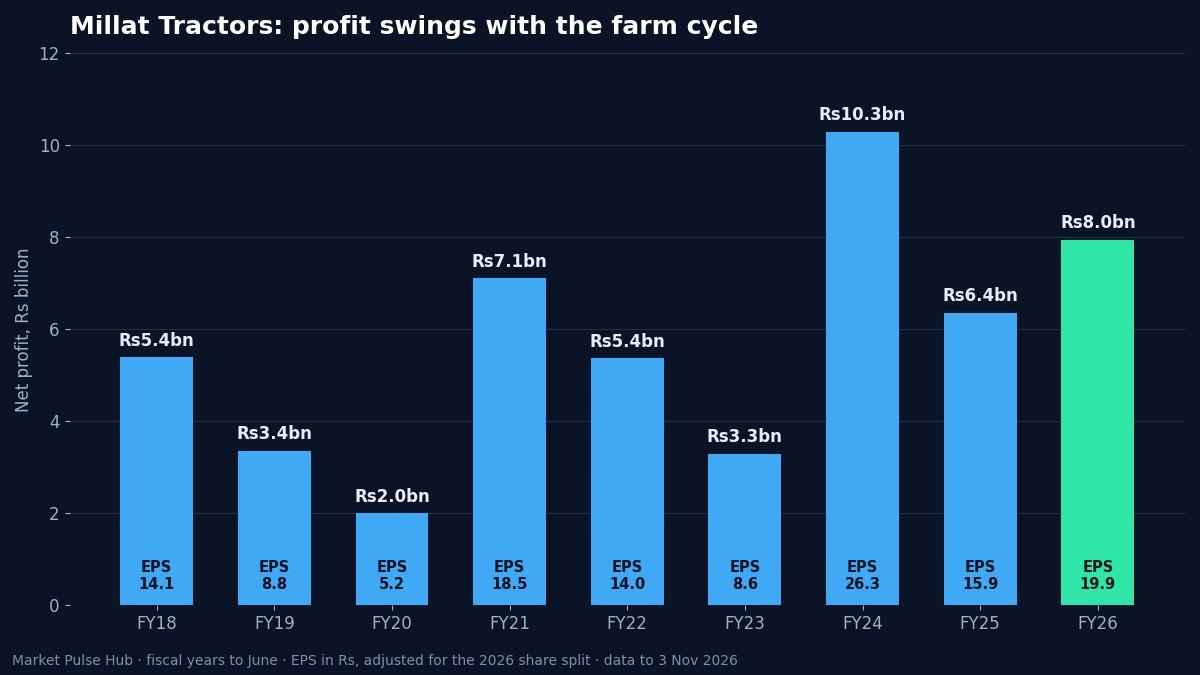
| Fiscal year (to June) | Net profit | EPS (Rs, split-adjusted) | Change in profit |
|---|---|---|---|
| FY2018 | Rs5.4bn | 14.05 | – |
| FY2019 | Rs3.4bn | 8.76 | −38% |
| FY2020 | Rs2.0bn | 5.20 | −40% |
| FY2021 | Rs7.1bn | 18.54 | +256% |
| FY2022 | Rs5.4bn | 13.99 | −24% |
| FY2023 | Rs3.3bn | 8.59 | −39% |
| FY2024 | Rs10.3bn | 26.32 | +213% |
| FY2025 | Rs6.4bn | 15.93 | −38% |
| FY2026 | Rs8.0bn | 19.91 | +25% |
The pattern is clear: profit doubles in good farm years and falls by a third or more in bad ones. FY2026 recovered to Rs8.0 billion, and the new year has started strongly.
| Jul to Sep 2026 | Jul to Sep 2025 | Change | |
|---|---|---|---|
| Sales | Rs10.9bn | Rs7.5bn | +45% |
| Profit after tax | Rs0.98bn | Rs0.51bn | +91% |
| Earnings per share | Rs2.46 | Rs1.29 | +91% |
How big could e-bikes be for Millat?
The market is growing quickly. Around 40,000 electric two-wheelers, mostly scooters, were sold in Pakistan in April 2026 alone, helped by high petrol prices. A tractor maker with strong dealer reach in rural Pakistan and 92% to 94% local content in its tractors has useful skills for assembly and distribution.
But the business is very different from tractors. Electric bikes are a crowded market with many Chinese brands and established motorcycle makers, prices are competitive and margins on assembled bikes are usually thin. Any profit will also sit first in MIPL, and it reaches Millat’s own accounts only through its share of the subsidiary.
| Measure | Millat today | How it reads |
|---|---|---|
| Sales, last 12 months | Rs67.6bn | – |
| Net profit, last 12 months | Rs8.3bn | net margin 12.3% |
| E-bike guarantee approved | up to Rs1.5bn | about 18% of a year’s profit, only if called |
| Free cash flow, last 12 months | Rs10.8bn | the guarantee is about 14% of it |
| Debt to equity | 1.3x | rising, the one red flag on its score |
On today’s numbers, even a successful e-bike business would take years to matter next to Rs67.6 billion of tractor and parts sales. The guarantee is the part with a near-term link to Millat’s finances: it costs nothing unless MIPL cannot repay its lenders, but it is a contingent liability that grows if the project needs more support.
Effect on growth
For the next one to two years, growth will come from tractors. The quarter to September 2026 showed sales up 45% and profit up 91% on a year earlier, which is the farm cycle and exports at work, not e-bikes. Over five years Millat’s sales grew about 7% a year and its profit about 2% a year, so the company does need a new source of growth. E-bikes could become one from 2027 onwards if MIPL launches on time and wins share, but there is no volume or price guidance yet to put a number on it.
Effect on dividends
Millat has paid a dividend every year for 20 years. Over the last 12 months it paid Rs21 a share (Rs10 interim in March 2026 and Rs11 final in October 2026), against earnings of about Rs20.8 a share over the same period, so it paid out roughly all of its profit. At Rs280 that is a yield of about 7.5%.
The e-bike project is funded by debt in the subsidiary, so it should not need Millat’s cash directly. The risk to the dividend is indirect. If MIPL needs more support, or if tractor profits fall again while debt is rising, the board has less room to keep paying out close to 100% of earnings. Because Millat pays out most of what it earns, its dividend has always moved with profit, so the swings in the annual table above are also a guide to how much the dividend can change from year to year.
Effect on the score
The Pulse Score is our score out of 100 that sums up a company’s growth, stability, valuation, working capital and cash flow; fair value is our estimate of what the shares are worth from earnings and cash flow. Both are estimates, not predictions. You can read how they work in our guide to reading a stock page.
| Measure | Value | Signal |
|---|---|---|
| Pulse Score | 67 out of 100 | above average |
| Fair value estimate | about Rs308 | 9% above the Rs280 price |
| P/E (last 12 months) | 13.5x | average |
| PEG | 0.47 | good |
| Dividend yield | 7.5% | good |
| EV / EBITDA | 6.9x | good |
| Price to book | 19x | expensive on book value |
| Return on equity | 70% | very high |
| Operating margin | 26% | good |
| Cash from operations vs profit | 147% | good |
| Piotroski F-score | 8 of 9 | strong |
| Sales growth, 5 years | 7% a year | average |
| Profit growth, 5 years | 2% a year | weak |
| Debt to equity | 1.3x and rising | watch |
Millat scores well on profitability and cash: high return on equity, strong margins, operating cash flow well above profit and a Piotroski F-score of 8 out of 9. It loses points for slow long-term growth, a high price to book and debt that has been rising, which is the one red flag. The fair value methods give a wide range, from about Rs80 on projected free cash flow to about Rs590 on earnings growth, so the Rs308 average is less certain than for steadier companies; see our explainer on fair value and margin of safety.
The e-bike project will not move the score until it shows up in the reported figures. A guarantee is not counted as debt unless it is called. If Millat puts cash into MIPL, takes on more debt for it, or if MIPL’s results start to appear in the group accounts, the stability and growth parts of the score will reflect that.
| What happens | Effect on growth | Effect on dividends | Effect on the score |
|---|---|---|---|
| E-bike project stays small or slow | None | None | None |
| E-bikes sell well from 2027 | Adds a second business once it shows in group results | Neutral at first, positive later | Growth score improves over time |
| E-bikes struggle and Millat has to support MIPL | Little | Payout could be cut to protect cash | Debt and stability scores fall |
| Tractor demand recovers (subsidy, tax, rates) | Main driver of profit | Higher payouts likely | Growth and valuation scores improve |
Risks to watch
- Farm cycle and policy: changes to sales tax on tractors, subsidy schemes and financing rates have the biggest effect on Millat’s profit. A National Tractor Policy has been drafted that would add financing incentives and tax breaks for local makers. The rate outlook matters too; see our guide to how SBP rate changes move stocks.
- E-bike execution: launch timing, the partner, prices and how much more support MIPL needs.
- Debt and cash: debt to equity of 1.3x and rising, plus about Rs6 to 7 billion of tax refunds stuck with the authorities.
- Exports: new markets have to make up for slower sales to Afghanistan.
What to watch next
- Monthly tractor sales figures from the auto industry association.
- Any MIPL announcement on the partner, models, prices or launch.
- The October to December 2026 results, due by 1 March 2027, and the interim dividend that usually comes with them.
- Whether debt to equity keeps rising in the next balance sheet.
For how Millat compares with other high-return companies, see our list of the most profitable companies on PSX. Millat’s live Pulse Score, fair value and results are on its stock page and the Market Pulse Hub dashboard.
Frequently asked questions
Is Millat Tractors making electric bikes?
Its subsidiary Millat Industrial Products Limited signed an agreement in May 2026 with a Chinese electric bike maker to assemble, make and sell e-bikes in Pakistan. The partner, models, prices and launch date have not been announced yet.
How much has Millat committed to the e-bike project?
Shareholders approved a corporate guarantee and other security of up to Rs1.5 billion for lenders financing the subsidiary’s e-bike project. That is a guarantee, not money spent, and it only costs Millat if the subsidiary cannot repay.
Will e-bikes increase Millat’s profit?
Not much in the next one to two years. Tractors make almost all of Millat’s sales and profit. E-bikes could add growth later if the subsidiary launches on time and wins share in a crowded market.
Is Millat’s dividend safe?
Millat has paid a dividend for 20 years in a row and paid about Rs21 a share over the last 12 months, close to all of its earnings. Payouts move with tractor profits, so a weak farm year or extra support for the e-bike business could lower them.
What is Millat Tractors’ Pulse Score?
As of 3 November 2026 Millat scores 67 out of 100, with a fair value estimate of about Rs308, about 9% above its Rs280 share price. Strengths are cash flow, margins and return on equity; weaknesses are slow long-term growth, a high price to book and rising debt.
Want to follow Millat’s score, fair value and results as they change? Join the Market Pulse Hub waitlist.
Bilal, Market Pulse Hub
Figures are from company results, exchange data and our calculations up to 3 November 2026 and will change as new data arrives. This article is for education only and is not investment advice.