Air Link Communication (AIRLINK), best known as Pakistan’s largest smartphone assembler and distributor, launched its own electric bike brand, AirV, in Lahore on 4 November 2026. The company says the lineup has 11 models across six series, with claimed ranges of up to 200 km depending on the variant. This article looks at what was announced, what is still missing, how big the opportunity could be for AIRLINK, and what the company’s balance sheet says about its ability to fund a new business. Prices and figures are up to 4 November 2026.
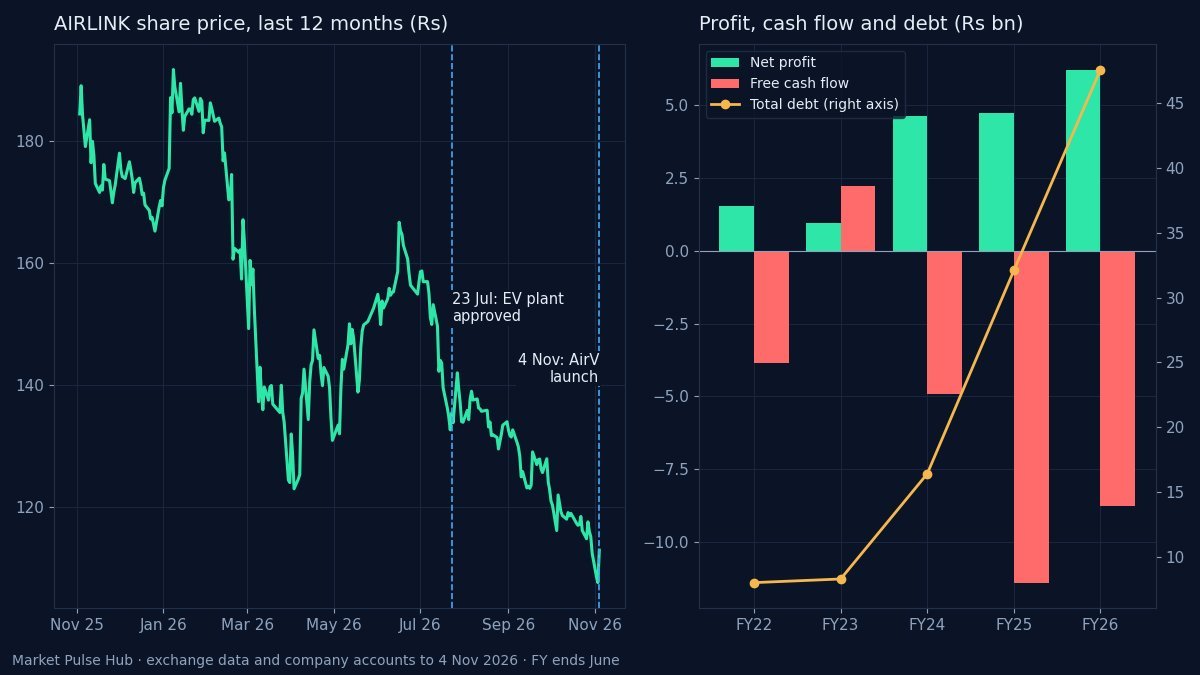
What Air Link announced
In a notice to the Pakistan Stock Exchange dated 4 November 2026, Air Link said the official launch of AirV was being held that day in Lahore and called it “the Company’s strategic entry into Pakistan’s electric vehicle industry”. The main points from the notice and launch coverage:
- Lineup: 11 electric bike models across six series.
- Range: up to 200 km on a charge for some models, depending on the variant. This is the top of the range, not a figure for every model.
- Features: cruise control, regenerative battery technology, NFC (tap-to-unlock) and anti-theft features.
- Where they are made: the company’s facility in the Sundar Green Special Economic Zone, Lahore. The board approved the electric bike project on 23 July 2026.
- Customers: both individual buyers and enterprise customers (for example delivery and fleet operators), sold through Air Link’s existing nationwide distribution network.
What was not disclosed matters just as much. The notice gave no prices, no investment amount, no production capacity, no named technology partner and no sales target. Business news coverage of the July approval also noted that the investment value, capacity and start date were not given.
The AirV lineup: indicative specifications
Before the launch, a pre-launch report by Flare listed the models in the company’s catalogue with motor power and range figures, noting that the specifications may vary. Batteries are lithium iron phosphate (LFP) or graphene, depending on the model. Treat these as indicative until Air Link publishes final specifications.
| Model | Motor power (watts) | Range (km) |
|---|---|---|
| Fleet | 2,500 to 3,000 | 180 to 200 |
| XR GT | 3,000 to 4,000 | 130 to 140 (top speed 80 km/h) |
| Vortax Pro | 2,000 to 2,500 | 120 to 130 |
| Glide Max | 1,500 to 1,800 | 80 to 100 |
| Z-Wing Max | not given | 90 to 100 |
| Glide Pro | 1,200 to 1,500 | 80 to 90 |
| XR | 2,500 to 3,000 | 80 to 90 |
| Z-Wing | not given | 80 to 90 |
| Z-Wing Pro | not given | 80 to 90 |
| Glide | 1,000 to 1,200 | 80 to 85 |
| Racy | 1,000 to 1,200 | 60 to 70 |
The spread is wide: from a small commuter scooter with 60 to 70 km of range up to a “Fleet” model rated at 180 to 200 km, which looks aimed at delivery riders and businesses that run bikes all day. That fits the company’s stated focus on enterprise customers as well as households.
Why Air Link is moving into electric bikes
A very large market. Pakistan is one of the world’s biggest motorcycle markets. Motorcycle sales reached a record of about 1.93 million units in FY26 (July 2025 to June 2026), above the previous peak of about 1.85 million in FY21, according to Arif Habib Limited data reported by PakWheels and TechJuice. Momentum continued into the new year: industry association figures show 172,416 motorcycles and three-wheelers sold in July 2026, up 38.4% from July 2025.
One dominant player. Atlas Honda sold about 1.69 million motorcycles in FY26, close to 88% of the market, with United Auto a distant second at about 190,800. A new technology is one of the few ways a newcomer can win share in a market this concentrated, which is why several companies are moving at the same time. Millat Tractors (MTL) said in May 2026 that it was evaluating electric bike production, and there have been reports of a Yadea assembly plant in Punjab.
Government support. The National Electric Vehicle Policy 2025-30, announced in June 2025, aims for 30% of new vehicles sold in Pakistan to be electric by 2030. It includes more than Rs100 bn of support over five years focused on two- and three-wheelers, starting with Rs9 bn in FY2025-26 for subsidised financing of 116,053 electric bikes and 3,171 electric rickshaws, with 25% reserved for women. It also exempts EV parts from some customs duties and sales tax and plans charging stations on the motorways. Many in the auto industry consider the 30% target ambitious, but the direction of policy is clear.
A fit with what Air Link already does. Air Link assembles phones and televisions at its Lahore facility, buys components in large volumes from abroad and runs one of the country’s widest consumer electronics distribution networks. An electric bike has far fewer parts than a petrol motorcycle and much of its value sits in the battery, motor controller and electronics, which is closer to Air Link’s core skills than to a traditional engine plant.
Air Link’s numbers before AirV
Any new business has to be judged against the company that is funding it. Air Link’s financial year ends in June.
| Financial year | Revenue (Rs bn) | Net profit (Rs bn) | EPS (Rs) | Free cash flow (Rs bn) | Total debt (Rs bn) |
|---|---|---|---|---|---|
| FY22 | 49.2 | 1.53 | 3.99 | -3.9 | 8.0 |
| FY23 | 36.9 | 0.96 | 2.50 | 2.2 | 8.3 |
| FY24 | 129.7 | 4.63 | 11.70 | -4.9 | 16.4 |
| FY25 | 104.4 | 4.75 | 12.01 | -11.4 | 32.1 |
| FY26 | 89.8 | 6.23 | 15.75 | -8.8 | 47.6 |
The table tells two stories. Profit has grown strongly: net profit rose from Rs 0.96 bn in FY23 to Rs 6.23 bn in FY26, and EPS from Rs 2.50 to Rs 15.75, even though revenue has fallen from its FY24 peak. Over the last twelve months Air Link earned Rs 5.60 bn on revenue of Rs 88.2 bn, a net margin of 6.4% and a return on equity of 22.7%.
The cash picture is weaker. Free cash flow has been negative in each of the last three years, adding up to about Rs 25 bn, and operating cash flow over the last twelve months was a negative Rs 11.0 bn. Total debt rose from Rs 16.4 bn in FY24 to Rs 47.6 bn in FY26, and debt is now about 1.9 times shareholders’ equity. Inventory takes about 105 days to sell and customers take about 87 days to pay, so a lot of cash is tied up in stock and receivables. Our checks flag that cash has not been following profits and that debt is rising.
That matters for AirV. Building an electric bike business needs working capital for batteries and parts, a dealer and service network, and probably consumer financing. Air Link will have to fund that from a balance sheet that is already carrying high debt, at a time when the State Bank of Pakistan policy rate is 12%.
How big could AirV be for AIRLINK?
Air Link has not given prices, capacity or a sales target, so any estimate is a scenario, not a forecast. The table below uses three sets of assumptions: the share of Pakistan’s motorcycle market that goes electric, AirV’s share of electric bike sales, and an average selling price. It keeps the market at the FY26 size of about 1.93 million units and assumes AirV earns a 5% net margin, a little below Air Link’s current 6.4%.
| Scenario | Electric share of market | AirV share of electric bikes | Average price (our assumption) | AirV units a year | Revenue (Rs bn) | Share of FY26 revenue | Added EPS (Rs) |
|---|---|---|---|---|---|---|---|
| Cautious | 2% | 10% | Rs 200,000 | about 3,900 | 0.8 | 0.9% | 0.10 |
| Middle | 5% | 20% | Rs 250,000 | about 19,300 | 4.8 | 5.4% | 0.61 |
| Strong | 10% | 20% | Rs 300,000 | about 38,600 | 11.6 | 12.9% | 1.47 |
Added EPS is the extra net profit divided by about 395 million shares. Against trailing EPS of Rs 14.33, the middle case would add about 4% to earnings and the strong case about 10%. In other words, even if AirV does well, electric bikes are unlikely to change Air Link’s earnings much in the next year or two. The bigger question is whether it becomes a long-term growth engine as the electric share of the market rises, and whether it can be funded without stretching the balance sheet further. Prices of electric scooters already on sale in Pakistan, from Chinese brands and local assemblers, will put a ceiling on how much AirV can charge.
How the market reacted
AIRLINK closed at Rs 112.90 on 4 November 2026, up 4.9% on the day, on volume of about 2.5 million shares, nearly four times its 30-day average of about 648,000. On 23 July 2026, the day the board approved the project, the shares closed 2.1% higher at Rs 135.43.
The bounce comes after a long fall. The share price is down about 36.5% over the past year, against a rise of about 6.4% in the KSE-100, and the 4 November rally came just after the stock touched Rs 104.53, its lowest level in 52 weeks (the 52-week high is Rs 199). At Rs 112.90 the company is worth about Rs 44.6 bn.
Valuation and Pulse Score
On the numbers, AIRLINK looks cheap: a price to earnings ratio of 7.9 times trailing earnings, a price to sales ratio of 0.5 and an EV/EBITDA of 7.5. Its earnings yield of about 12.7% is slightly above the 12.0% T-bill yield. The dividend yield is low at about 1.8%. The stock is a member of both the KSE-100 and the KMI-30 Shariah index.
Its Pulse Score, our score out of 100 for growth, stability, valuation, working capital and cash flow, is 49.4. It scores well on profit growth and valuation but poorly on cash flow and debt. Our fair value estimate of about Rs 347 implies a large margin of safety, but that estimate leans on reported earnings, and when profit is not backed by cash, earnings-based models can overstate value. Read more in our guide to intrinsic value and margin of safety, and see how Air Link compares with Systems, NetSol, TRG and PTCL in our technology stocks guide.
Risks to watch
- Funding: debt of Rs 47.6 bn and negative operating cash flow leave little room if AirV needs large upfront spending on inventory, dealers or financing schemes.
- Competition: cheaper imported and locally assembled electric scooters are already on sale, and larger motorcycle makers can enter with strong brands and dealer networks.
- Imported parts and the rupee: batteries and motors are largely imported, so a weaker rupee or higher duties would raise costs.
- After-sales service: buyers will want spare parts, battery warranties and repair shops nearby. Air Link’s network sells phones; servicing vehicles is a new skill.
- Policy dependence: demand for electric bikes leans on subsidised financing and duty concessions, which can change with each budget.
- Charging: Pakistan still has few public charging points, so most riders will need to charge at home, which suits short commutes more than long rides.
What to watch next
- Model-wise prices, battery warranties and booking terms for the 11 AirV models.
- Whether AirV bikes qualify for the government’s subsidised financing scheme under the NEV Policy.
- Any disclosure of plant capacity, investment, localisation level or a technology partner.
- The half-year results to 31 December 2026, due by early March 2027, for the first sign of AirV sales and any change in debt and cash flow.
Frequently asked questions
What is AirV?
AirV is Air Link Communication’s electric bike brand, launched in Lahore on 4 November 2026. The first lineup has 11 models across six series, assembled at the company’s facility in the Sundar Green Special Economic Zone.
How much does an AirV electric bike cost?
Air Link had not announced model-wise prices at the time of writing. Wait for official prices and full specifications before paying any advance.
What range does an AirV bike have?
The company says ranges are up to 200 km depending on the variant. Pre-launch catalogue figures put most models between 60 and 140 km, with the Fleet model at 180 to 200 km.
Will AirV boost AIRLINK’s profits?
Possibly, but probably not by much at first. In our middle scenario, AirV would add about Rs 0.61 to annual EPS, about 4% of current earnings. Its long-term value depends on how fast Pakistan’s two-wheeler market goes electric and how much share AirV wins.
Is AIRLINK Shariah-compliant?
AIRLINK was a member of the KMI-30 index in our latest data. Index membership is reviewed regularly.
Follow AIRLINK’s price, ratios and results on its stock page and the free Market Pulse Hub dashboard, and join the waitlist to get new tools and reports first.
Bilal, Market Pulse Hub
Figures are from company results, exchange data and our calculations up to 4 November 2026 and will change as new data arrives. This article is for education only and is not investment advice.