The dividend income Pakistan investors can earn from PSX stocks is one of the simplest ways to make money from the stock market without selling shares: you own part of a company, and when it shares its profit as a cash dividend, the money lands in your bank account. This guide uses our data on 245 listed companies, up to 6 November 2026, to show which PSX companies have paid every year, how to judge whether a dividend can last, and how tax at source changes what you actually receive.
How dividend income from PSX stocks works
A listed company’s board announces a dividend along with its results, usually as rupees per share. The company then sets a book closure period, and each dividend also has an ex-dividend date. Shares bought on or after the ex date trade without that dividend, so you need to hold them before it. For example, Allied Bank (ABL) paid Rs 4.00 a share with an ex date of 28 August 2026, book closure from 31 August to 2 September 2026 and payment on 9 September 2026, according to our dividend records.
The cash is sent to the bank account linked to your CDC account through your broker, after tax is deducted. The yield is the yearly dividend divided by the share price. Our guide to dividend yield explains the maths, and the highest dividend yield stocks list ranks every company by yield.
Consistency matters more than one year’s yield
A high yield this year tells you little if the company skips the next one. Across the 245 companies in our dividend records, 56 paid a cash dividend in each of the last 10 years and 52 paid none in that period. Among 98 KSE-100 members with records, 38 paid in every one of the last 10 years.
A long record does not guarantee future payments, but it shows a business that has kept generating spare cash through different interest rate cycles, devaluations and slowdowns. That is the kind of history an income investor usually wants to see first.
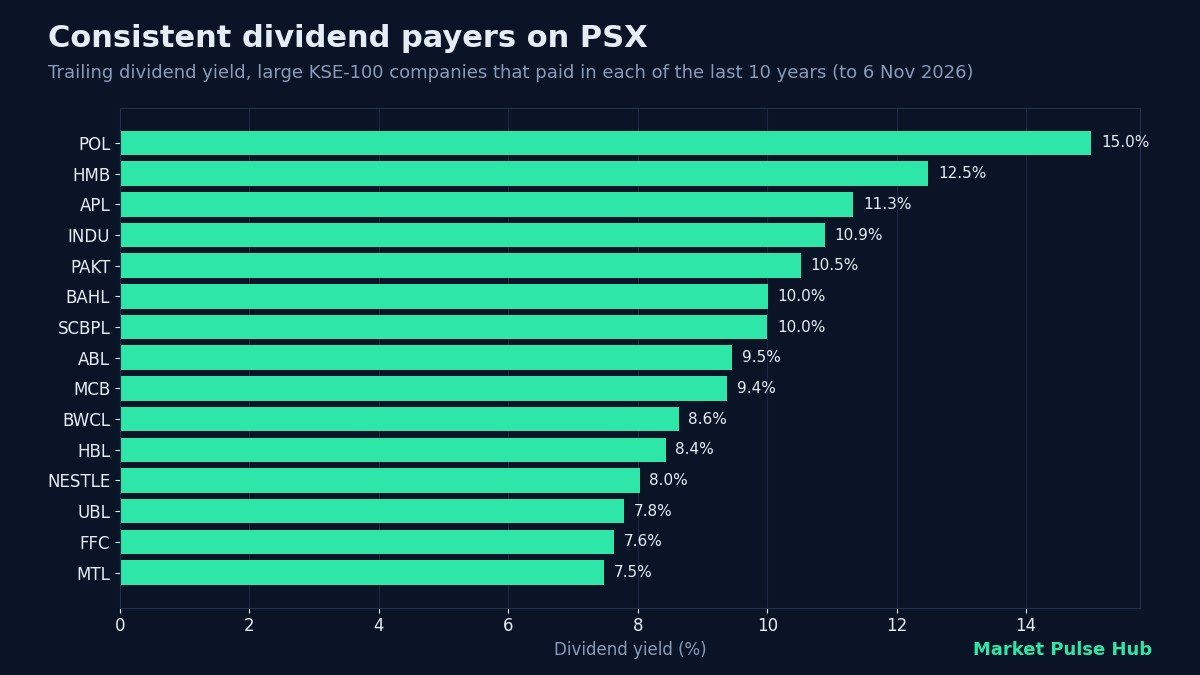
Dividend income Pakistan: the most consistent large payers
30 KSE-100 companies with a market value of at least Rs 50 bn paid a dividend in each of the last 10 years. The table shows the 15 with the highest trailing yield. “Years in a row” counts consecutive years with a dividend in our records, which go back up to 20 years. “5y growth” is the yearly growth rate of the dividend per share over five years. The Pulse Score is our estimate of a company’s financial quality and value, scored out of 100 from about 30 checks on growth, stability, valuation, working capital and cash flow taken from its published accounts. Fair value is our estimate of what a share is worth, averaged from several methods based on earnings and cash flow; both are estimates, not price targets.
| Symbol | Company | Price (Rs) | Dividend yield | Years in a row | 5y growth | Payout ratio | Pulse Score (out of 100) |
|---|---|---|---|---|---|---|---|
| POL | Pakistan Oilfields Limited | 663.08 | 15.0% | 20 | 14.9% | n/a | 74.3 |
| HMB | Habib Metropolitan Bank Limited | 99.00 | 12.5% | 15 | 21.7% | n/a | 60.2 |
| APL | Attock Petroleum Limited | 560.08 | 11.3% | 19 | 22.7% | n/a | 74.3 |
| INDU | Indus Motor Co. Ltd. | 1,822.36 | 10.9% | 20 | 13.5% | 60.1% | 69.3 |
| PAKT | Pakistan Tobacco Co. Ltd. | 1,452.94 | 10.5% | 20 | 19.7% | n/a | 71.4 |
| BAHL | Bank Al Habib Ltd. | 162.24 | 10.0% | 20 | 27.2% | 55.7% | 75.7 |
| SCBPL | Standard Chartered Bank (Pakistan) Limited | 59.79 | 10.0% | 16 | 18.8% | n/a | 72.0 |
| ABL | Allied Bank Limited | 172.01 | 9.5% | 20 | 14.9% | 53.4% | 60.4 |
| MCB | MCB Bank Limited | 399.48 | 9.4% | 20 | 12.5% | 73.3% | 63.7 |
| BWCL | Bestway Cement Limited | 456.66 | 8.6% | 14 | 23.4% | 93.3% | 74.9 |
| HBL | Habib Bank Limited | 299.89 | 8.4% | 19 | 36.3% | n/a | 65.5 |
| NESTLE | Nestle Pakistan Ltd. | 6,899.58 | 8.0% | 20 | 23.5% | 145.2% | 65.5 |
| UBL | United Bank Limited | 425.34 | 7.8% | 20 | 37.5% | 54.7% | 77.2 |
| FFC | Fauji Fertilizer Co. Ltd. | 562.62 | 7.6% | 20 | 27.0% | 66.7% | 80.5 |
| MTL | Millat Tractors Limited | 292.30 | 7.5% | 20 | 8.8% | n/a | 67.2 |
These 30 companies come from 13 sectors, with banks, oil and gas, fertilizer and consumer goods prominent. Payout ratio is shown as n/a where our data does not have a reliable figure. Prices and yields move every day, so check the latest figures on each stock page or on the Market Pulse Hub dashboard.
Payout ratio: can the dividend last?
The payout ratio is the share of profit paid out as dividends. A company paying 30% to 60% of profit keeps a cushion: if profit falls, it can still pay something. A company paying close to or above 100% has little room. Among the 30 consistent large payers, Nestle Pakistan (NESTLE) shows a payout ratio of 145.2% and Unilever Pakistan Foods (UPFL) 100.0%, while OGDC is at 30.2% and PPL at 33.4%.
A high payout is not automatically bad. Mature consumer companies with little need for new factories often pay out most of their profit. But when a high payout comes with falling profit or rising debt, the dividend is more likely to be cut. Our payout ratio explainer walks through more PSX examples.
Tax on dividends is deducted at source
Dividends are taxed before you receive them under section 150 of the Income Tax Ordinance 2001. The FBR Withholding Tax Rate Card, updated up to 30 June 2026 as per the Finance Act 2026, gives a general rate of 15% for persons on the Active Taxpayers List (ATL) and 30% for those not on it. Dividends from Independent Power Producers are taxed at 7.5% for ATL persons and 15% for others, and companies that pay no tax because of exempt income or carried-forward losses have dividends taxed at 25% and 50%.
Here is what that means in rupees. The median yield of the 15 companies in the table is 9.46%. Rs 100,000 invested at that yield would bring gross dividends of about Rs 9,460 a year. A filer on the ATL would receive about Rs 8,041 after 15% tax, and a non-filer about Rs 6,622 after 30%. Being on the ATL makes a real difference to income investors. Our guide to PSX capital gains tax and dividend tax covers the full picture; confirm your own case with your broker or a tax adviser.
Building a dividend portfolio step by step
- Start with the record: look for companies that have paid for many years in a row, not just this year.
- Check the payout ratio and debt: a payout well below 100% and low borrowing leave room for bad years.
- Spread across sectors: banks, energy, fertilizer and consumer companies are affected by different things, such as interest rates, gas prices and consumer demand.
- Watch for yield traps: a yield that looks unusually high is often a sign the share price has fallen because the market expects lower profit.
- Decide whether to reinvest: putting dividends back into shares lets the income compound over time.
- If you want Shariah-compliant income, 7 of the 30 companies above are KMI-30 members; see our KMI-30 stocks list.
You can try different amounts and yields in the dividend income calculator on the dashboard, which also shows each company’s dividend history.
Frequently asked questions
How much dividend income can I earn from PSX?
It depends on how much you invest and the yields of the shares you hold. As an illustration, Rs 100,000 at a 9.46% yield gives about Rs 9,460 a year before tax and about Rs 8,041 after 15% tax for a filer. Yields change with prices and company decisions, so actual income will differ.
Which PSX companies have paid dividends every year?
In our records, 56 of 245 listed companies paid a cash dividend in each of the last 10 years, including 38 KSE-100 members. The table above lists the 15 highest-yielding large ones as of 6 November 2026.
What is the tax on dividends in Pakistan?
According to the FBR Withholding Tax Rate Card updated to 30 June 2026, the general rate under section 150 is 15% for persons on the Active Taxpayers List and 30% for others, with different rates for IPPs and some other cases. Check with a tax adviser for your situation.
When do I need to buy shares to get a dividend?
You need to own the shares before the ex-dividend date. Shares bought on or after that date trade without the announced dividend. Your broker can confirm the dates for any company.
Is a high dividend yield always good?
No. A very high yield can mean the share price has dropped because profits are expected to fall, and the dividend may be cut. Look at the payout ratio, debt and the dividend record before relying on a yield.
Want alerts when scores, fair values and results change? Join the Market Pulse Hub waitlist.
Bilal, Market Pulse Hub
Figures are from company results, exchange data and our calculations up to 6 November 2026 and will change as new data arrives. This article is for education only and is not investment advice.